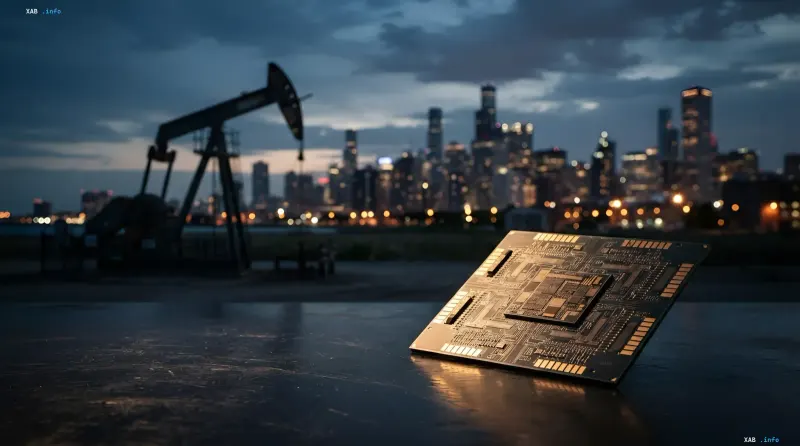
Deutsche Bank analysts have proposed a new concept that, in their assessment, describes the shift in one of the global financial system's core mechanisms: semiconductors are gradually displacing oil as the source of global dollar dominance. The model, dubbed the "chip dollar" by the bank, suggests that revenues from Asian microchip manufacturers are increasingly directed not into US government bonds, but into American technology companies. This was reported by Fortune, citing a Deutsche Bank study. According to the bank's FX strategist Mallika Sachdeva, for the first time in modern history, the volume of global semiconductor trade has surpassed the trade volume of oil and gas.
Historical Turning Point in Trade Balance
The shift in global trade structure pointed out by Deutsche Bank is structural rather than temporary. The trade surplus of Asian countries in chips—excluding China—is already comparable to the surplus of Persian Gulf states generated by oil exports. One of the main drivers of this sharp market growth has been massive investment in artificial intelligence by cloud infrastructure operators: according to the bank, their capital expenditures next year could exceed $1 trillion. Analysts argue that this exact capital flow supports the new "chip dollar" circuit.
How the New Mechanism Works
The petrodollar system took shape following the 1974 agreement between the US and Saudi Arabia, under which the kingdom committed to pricing oil in dollars and channeling a portion of its revenues into US assets, primarily government bonds, while Washington guaranteed Saudi security and freedom of navigation in the Strait of Hormuz in return. Now, according to Deutsche Bank, this model is being replaced by an arrangement where Asian chip export revenues support the American technology market. Specific metrics illustrate the scale of this capital reallocation: about 90% of South Korean household equity investments flow into the US market, and foreign investments in US stocks are more than double foreign holdings of the country's Treasury bonds. Industry structure amplifies this effect: despite Asia's dominance in microchip manufacturing, US companies capture about 70% of its profits, with Japan, South Korea, and Taiwan playing critical roles in advanced chip supply chains.
Model Risks and Market Reaction
However, the "chip dollar" carries a significant vulnerability: its sustainability depends on whether actual demand for computing power can justify the massive investments in artificial intelligence. If expectations fall short, tech company revenues and semiconductor demand could drop sharply. These fears are already reflected in the stock market: in recent weeks, technology stocks have declined amid doubts over the continuation of the AI boom. According to The Wall Street Journal, the sell-off in certain equities in 2026 proved comparable to the dot-com crash of 2000—for instance, Oracle shares plunged 60% from their yearly highs compared to 37% in 2000, while Seagate shares dropped 60% against 37%. Meanwhile, the current sell-off has primarily affected artificial intelligence-related companies and data center equipment manufacturers.
Thus, the "chip dollar" is not merely a change of commodity in the trade balance, but potentially a new architecture where US technological leadership and Asia's manufacturing might mutually reinforce the status of the dollar. Yet unlike the petrodollar, which relied on physical demand for energy resources, the resilience of the new model is directly tied to the commercial returns on AI investments—and that is precisely where the main risk for the entire structure is concentrated.