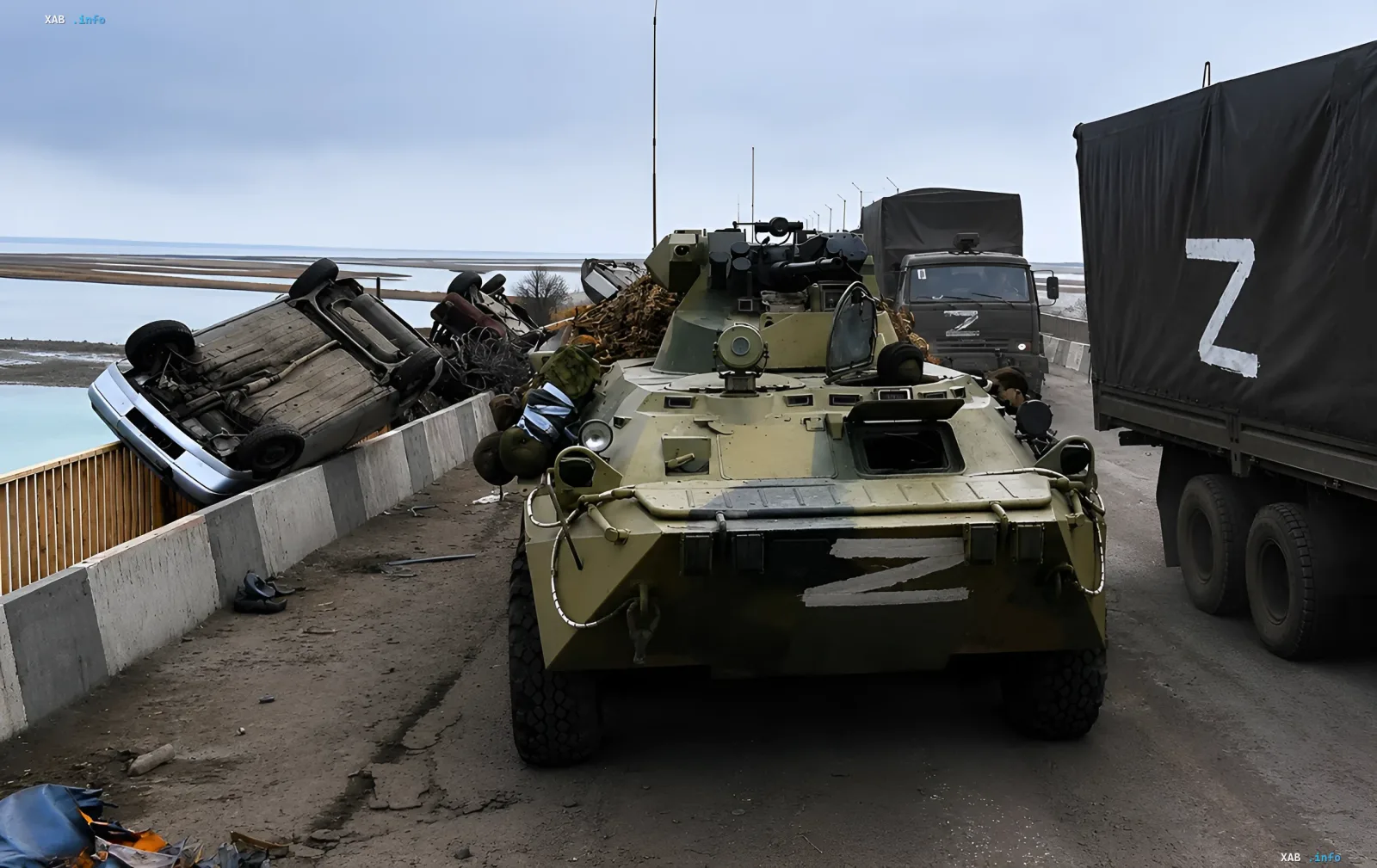
A key logistical hub in the temporarily occupied territory of the Kherson region — the Chongar Bridge — has sustained critical damage and completely halted traffic. A series of successful strikes by Ukrainian drones on June 7 and 9 rendered the crossing unusable for both cargo and passenger vehicles.
The scale of the destruction and its consequences for Russian logistics were described by Dmitry "Perun" Filatov, commander of the 1st Separate Assault Regiment named after Dmytro Kotsubailo, in an interview with "Suspilne Studio". According to him, the damage to the bridge is critical for the entire structure, and its restoration will require extensive work.
Disruption of Enemy Plans and Strike on Convoy
Attempts by the occupation authorities to redirect traffic flows have led to new losses for the Russian side. As Filatov noted, the enemy began deploying pontoon crossings and changing logistical routes, transferring cargo through Arмянск. However, Ukrainian forces fully control the situation and are exploiting this vulnerability.
"We carried out another operation. We will tell you later how it went. Because the Chongar Bridge was damaged, the enemy concentrated a large number of trucks with military cargo moving specifically through Arмянск. Accordingly, during the strike, we managed to hit trucks carrying fuel and ammunition. There were about 50 vehicles, and some of them were destroyed," the commander shared.
"Epicenter of Multi-Domain Operations"
The success of these operations was made possible by the creation of a joint command post, which the 1st Separate Assault Regiment named after Dmytro Kotsubailo organized together with the 475th Assault Regiment. This headquarters was named the "Epicenter of Multi-Domain Operations".
At its core is a cyber intelligence department conducting in-depth study of the enemy. This allows for obtaining information from within and making operational decisions. Filatov explained that the decision to strike the Chongar Bridge was made based on data that the enemy planned to deliver fuel specifically through it. From the moment the decision was made to its execution, only six hours passed.
"We planned the operation on the Arмянск Bridge in advance, as we assumed this route would also be used. Therefore, we acted more preparedly," added "Perun".
Long-Term Effect and Supply Problems
According to the military man, such actions have a quick and long-term effect. Currently, the RF cannot properly supply its units, and in the future, it will have to spend significant resources on restoring destroyed routes. Commanders on the front lines have to find new ways of supply, which reduces the effectiveness of their actions.
"This operation would not have been possible if other units had not struck Mariupol and the road to Berdyansk. This is what led to the fact that units standing on the Huliaipole direction began to be supplied not through the Mariupol highways, but through Crimea. That is, they began to ferry trucks to Crimea via pontoons and then drive from Crimea here. We understood this, quite quickly blocked these routes for them, and continue to further weaken the enemy," Filatov said.
Chronicle of Destruction
The first strike on the Chongar Bridge was carried out on Sunday, June 7. After this, traffic on the crossing was restored in a reversible mode. However, on June 9, the bridge was attacked again by drones, causing traffic to be suspended again. After this, the occupation so-called authority recommended using alternative routes through Arмянск and Perekop.
The Center for Coordination of Defense Actions (CCDA) reported that the Chongar Bridge was completely destroyed after several drone strikes. In addition, on the morning of June 10, the bridge between Henichesk and the Arabat Spit was blocked on the temporarily occupied part of the Kherson region. This is already the second important crossing whose traffic the occupiers have stopped in recent days after the Chongar Bridge.
On the night of June 11, explosions were heard in Crimea — public pages reported fires in Simferopol and Sevastopol. There is also information about damaged bridges at land entrances. The loss of the Chongar Bridge deals a serious blow to the logistics of Russian troops on the front, exacerbating problems with the delivery of fuel and ammunition.


