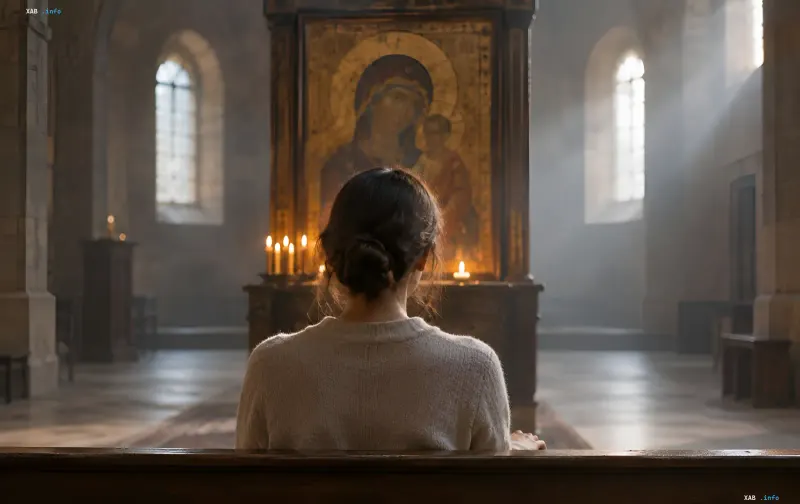
Dreams featuring a church, temple, or holy images leave people with contrasting feelings: some wake up with a sense of peace, while others feel anxious and experience unexplained internal tension. The most questions arise when a dream involves praying, lighting a candle, or seeing an unusual icon. An article by Styler (a RBC-Ukraine project) explores which details of the dream deserve attention and how various interpreters analyze them — from traditional Miller's dream book to Carl Gustav Jung's psychological approach.
Church and Temple as a Symbol of Inner Support
In symbolic interpretations, a church is most often associated with the search for so-called inner support, the need for protection, the reassessment of one's actions, or the desire to find answers to complex questions. At the same time, the specific appearance of the structure in the dream matters: the temple can act as a reflection of a person's inner world. In psychological terms, as Carl Jung asserts in his work, such dreams reflect the need to restore mental equilibrium or return to what holds personal value for an individual.
Icons: One of the Most Emotionally Charged Images
Icons are among the most emotionally charged images in such dreams. According to Styler, their appearance may be linked to personal beliefs, memories of relatives, religious experiences, or the need for protection. This is why the interpretation of an icon largely depends on which specific image was dreamed of and what feelings it evoked in the sleeper.
Actions in a Dream Set the Emotional Context
A person's actions in a dream are equally important: they help better understand its emotional context. For instance, praying before an icon or lighting a candle are perceived as more 'active' plots than simply staying in a temple, and interpreters often separate their meanings. In traditional dream books, the meaning of a plot is sometimes further divided depending on who had the dream, whereas the psychological explanation primarily relies on a person's personal experience and life circumstances.
How Gender Affects Plot Interpretation
In a scientific study on the relationship between psychological needs, emotional state, and dream plots, a church or temple in a dream for a woman may symbolize the need for emotional support, peace, and a sense of security; if a woman prays before an icon, it can be viewed as a reflection of worries about relatives or a desire to find a way out of a difficult situation. As for men, such a plot, according to the same data, may be linked to reconsidering their own decisions, responsibility for loved ones, or the search for clear life guidelines, while being in an empty temple may reflect the need to be alone and sort through one's thoughts.
Jung's Approach and the Absence of a Universal Dictionary
Swiss psychiatrist Carl Gustav Jung paid special attention to religious images and symbols in the human psyche. In his approach, outlined by the JSTOR portal, such images could hold deep personal meaning and reflect internal processes that a person is not always aware of. At the same time, researchers note that there is no universal dictionary that can reliably decode every dream — the meaning of religious images depends on personal associations, beliefs, and the specific context of the individual.