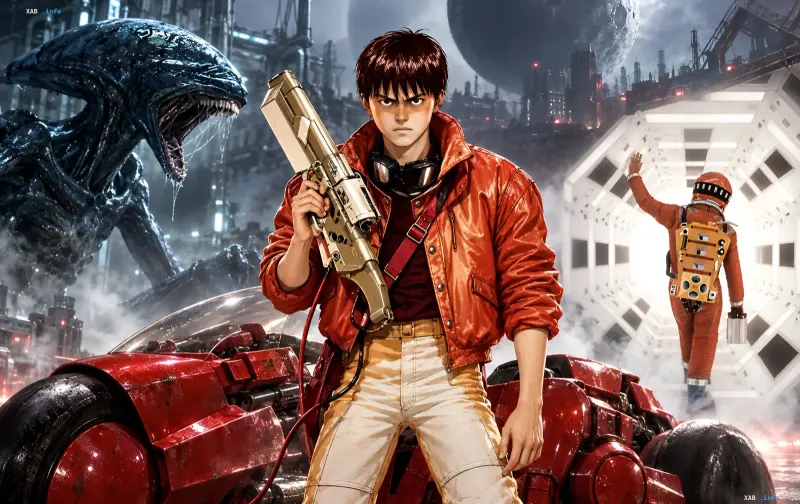
There are films that lose their magic over years: special effects look outdated, costumes betray their era, and the plot no longer surprises. But there are also works that have survived decades and can still compete with modern premieres. They feature futuristic cities, ahead-of-their-time technologies, incredible animation, and directorial decisions that filmmakers still use today. Styler has put together a selection of eight past films that can easily be mistaken for new releases, and below we break down the key works from this list.
Kubrick and Space Before the Moon Landing
Imagine a space travel film shot even before the first human moon landing, and its depiction of space still looks convincing today. That is precisely what Stanley Kubrick's sci-fi masterpiece 2001: A Space Odyssey became. According to the plot, an expedition sets off for Jupiter to investigate a mysterious object linked to the mystery of human origin. On board the ship, HAL 9000 operates — an artificial intelligence that controls systems and helps the crew, yet doubts gradually arise as to whether one can trust a computer that makes decisions instead of humans.
The film impresses not only with its story, but also with its visual solutions: Kubrick used large-scale models of spacecraft, folding mechanical structures, and optical effects. Symmetrical interiors, the smooth rotation of space stations, and minimalist design resemble modern concepts of future space missions, and the theme of artificial intelligence sounds even sharper today than it did in 1968.
Alien: Space as a Survival Ground
A spacecraft resembling an old industrial factory rather than a futuristic liner, an unknown creature, and a trapped crew — this is how Ridley Scott turned space from an adventure space into a place where every dark corridor can hide danger. The crew of the cargo ship Nostromo receives a signal from an unknown celestial body, and during the investigation, one of the team members contacts an unknown life form. After that, a struggle for survival begins on board, and the crew gradually realizes how defenseless they are against the creature.
The film is distinguished not only by the alien's design created by artist H.R. Giger, but also by the environment itself: pipes, metal structures, flickering indicators, and narrow passages create the feel of a real spacecraft. There is no sterile futuristic beauty here — there is heavy machinery that still looks convincing today, and the main character Ripley became one of the most famous heroines in science fiction.
Blade Runner and the Aesthetics of Cyberpunk
Neon advertising screens, giant skyscrapers, non-stop rain, and a city where people get lost among technologies — this is how Ridley Scott imagined future Los Angeles in a film that became one of the main visual reference points for cyberpunk. Harrison Ford plays Rick Deckard, a former police officer tasked with hunting down replicants, artificially created beings almost indistinguishable from humans. During the investigation, the hero faces not only dangerous opponents, but also questions with no easy answers: what makes a human human and does artificial life have its own value.
The film was released more than four decades ago, but its cityscape is easy to imagine in a modern video game or sci-fi series. The director portrayed the future not as a shiny technological paradise, but as an overpopulated metropolis with social inequality, pollution, and an excess of advertising — it is this gloomy aesthetic that made the film cult.
Akira and Robots Ahead of Their Time
If complex animation, neon megacities, and spectacular motorcycle races seem like inventions of recent years, the Japanese film Akira can change that perception. Katsuhiro Otomo's film became one of the most important works in the cyberpunk genre: events take place in Neo-Tokyo, a city rebuilt after a massive disaster. Teenager Kaneda and his friend Tetsuo get caught up in a story related to secret government experiments, and when Tetsuo gains amazing abilities, his life and the future of the entire city are put at risk.
Akira impresses with the detail of the city, complex character movements, and the dynamics of scenes: animators paid attention even to such trifles as lip movement during conversation and the naturalness of lighting, making Neo-Tokyo feel like a living place rather than a mere painted background. In Styler's selection, it stands alongside other ahead-of-their-time works — for example, a story about a robot that can pass through a metal grate, change appearance, and restore its body after damage. The visual style of these films influenced the international popularity of Japanese animation and continues to inspire creators of science fiction.
Why These Films Do Not Age
What all the listed works have in common is a commitment to a convincing environment and relevant themes rather than lame special effects. Kubrick's scale models and optics, the heavy industrial aesthetic of Alien, the gloomy neon of Blade Runner, and the detailed animation of Akira still serve as benchmarks for filmmakers. That is precisely why these films of the past can easily be mistaken for new releases — and that is why they remain on the must-watch list for those who follow how cinema predicts the future.