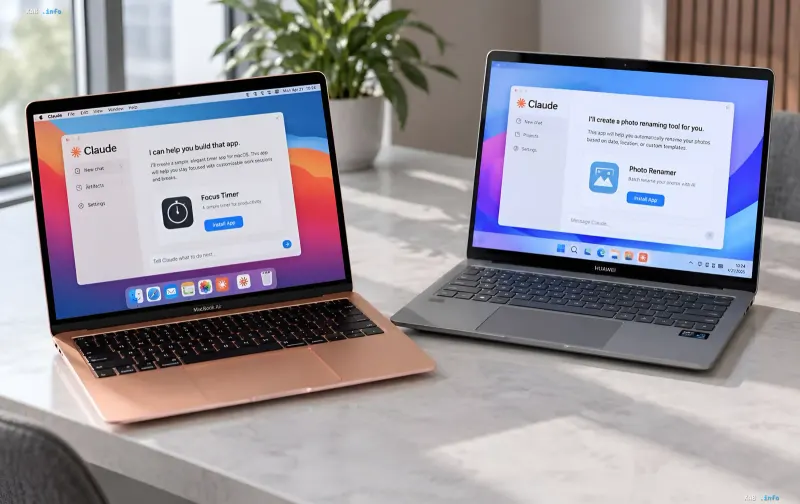
On November 24, 2026, Anthropic launched a beta feature allowing users to convert Claude-generated artifacts—such as timers, trackers, photo renaming tools, and other utilities—into full-fledged desktop applications for macOS and Windows. By simply selecting the "Install as app" option in the artifact interface, the installed program gains its own icon, a standalone window, and launches like a standard desktop application. The feature is available across all subscription plans—Free, Pro, Max, and Ultra—making it one of the most accessible innovations from Anthropic in recent times.
Technical Requirements and Platform Limitations
Using the new feature requires the Claude desktop client for macOS or Windows, version 6.28899.0 or later. Each application requires a constant internet connection and authentication within the desktop client. At launch, the feature is not supported on Linux, the web version of Claude, or mobile devices. Furthermore, the option is unavailable for artifacts created from pre-defined templates—specifically Docs, Slides, and Sheets—as well as for organizations whose settings comply with HIPAA requirements. Creating an app and every subsequent request to Claude consumes the usage limit of the selected tier.
Permission Model: What an App Can and Cannot Do
By default, an installed application can only perform operations permitted in the browser. Any action beyond this boundary requires explicit user confirmation via an "Allow" or "Don't allow" prompt. Requested permissions include sending notifications, responding to hotkeys while working in other applications, pinning the window on top of others, and adding an icon to the macOS menu bar or the Windows system tray. Of particular note is the "always on top" permission: with this access, the app gains the ability to read mouse cursor coordinates on the user's screens, which opens potential vectors for activity monitoring.
Full Access and Trust Policy
The highest level of privilege, "Full access to this computer," allows the application to launch other programs, as well as read, modify, and delete files without further confirmation. Anthropic explicitly states that it does not verify applications before installation and recommends granting full access only when the user trusts all authors of the code. In Free, Pro, Max, and Ultra plans, all users outside an organization are automatically considered external, so shared applications passed to acquaintances will generally not be able to obtain full access. In the Team plan, the feature is enabled by default, but full access can only be granted by an administrator. In Enterprise, it is disabled by default and must be activated by the account owner.
Updates, Revoking Permissions, and Security Blind Spots
Every granted permission is tied to a specific version of the application. After any update—including the user's own code modifications—Claude requests confirmation again. However, code that an app loads from an external site can change without notifying the user, creating a "blind spot": the user approved one version of the logic, but an entirely different one is actually executing. To revoke permissions on macOS, click the app name in the menu bar; on Windows, right-click the title bar and open the Permissions item. Disabling full access stops the app's running processes but does not undo changes already made to the file system. When access to a shared application is lost, its processes may continue to run for up to 20 minutes.
Context: The Race for Desktop AI Agents
The launch of Claude desktop artifacts fits into a broader trend of integrating AI assistants with operating systems. Google is concurrently developing capabilities for Gemini to interact with applications on macOS, and in early November 2026, the Postman service independently integrated with Claude Code and Codex. Thus, the market is rapidly moving toward a model where AI agents do not just generate code in a browser but gain direct privileges at the operating system level. The balance between convenience and security, which Anthropic addresses through a multi-layered permission system, will likely become a key industry topic in the coming months.