
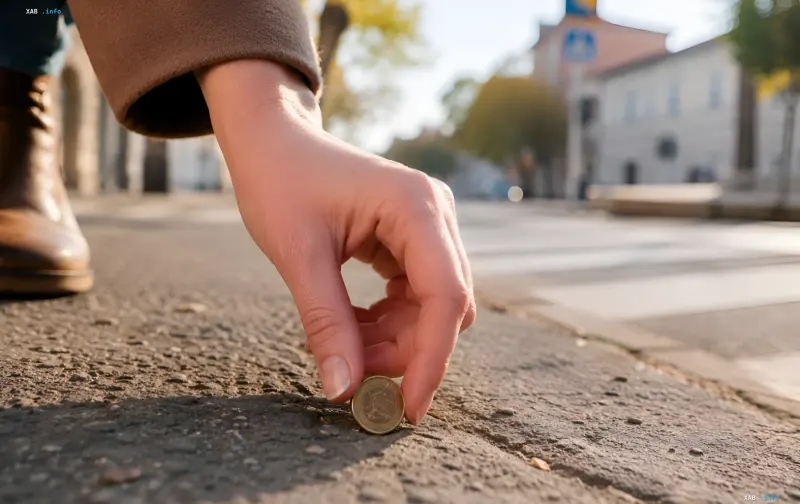
In the era of digital payments and contactless cards, a physical coin lying on the asphalt seems like an archaic relic of the past. However, as practice shows, even in 2026, finding money on the road evokes a range of emotions in passersby — from joy to superstitious fear. On August 14, 2026, as summer draws to a close, we decided to look into the phenomenon of "money from the ground," relying on archives of folk beliefs and expert opinions.
The myth of "someone else's misfortune" and the symbolism of the crossroads
The roots of fear regarding found money go deep into history, when currency was perceived not just as a means of exchange, but as a carrier of the owner's energy. According to ancient beliefs, money constantly passed from hand to hand, absorbing the fate, illnesses, and troubles of its owners. This is why folk wisdom says: not every find should be taken home.
Special attention in folklore is paid to the place of the find. The crossroads was traditionally considered a place of power and a boundary between worlds, a place where destinies intersect. A coin found specifically at a crossroads was often interpreted as a "ransom" or an attempt by the owner to get rid of something negative. Superstitious people believed that by picking up such a coin, a person takes on someone else's problems, illnesses, or even curses that the previous owner wanted to escape.
The paradox of luck: when a find becomes a blessing
However, the world of folk signs is not black and white. There is also an opposite interpretation: a coin found by chance can foretell good luck, unexpected profit, or financial growth. The key factor here is the principle of randomness. If a person did not look for money specifically but simply noticed them with their eyes, this was considered a sign from above.
The orientation of the coin also played an important role. If it lay "heads" up, this was perceived as a good sign, an invitation to luck. The threshold of the house also had special significance: money found at the entrance could be interpreted as a gift from the house spirit or ancestors, unlike coins on the roadway, which were considered "dirty".
Economic ethics: what to do with a find in 2026
Putting aside the mysticism, let's look at the situation from a practical and legal point of view. In the modern world, where every penny counts, finding money on the street is primarily a matter of ethics. If it is a small amount, the decision remains up to the person's personal beliefs. But if a wallet, documents, or a large sum are found on the ground, it is wiser to try to find the owner or turn the find over to the police.
Interestingly, superstitions also prescribed not spending found money immediately. It was believed that thoughtless spending of "accidental wealth" means a casual attitude towards luck, which could lead to a quick parting with it. In a modern context, this can be interpreted as advice not to make impulsive purchases with "easy" money.
Contradictory data
When analyzing sources, a clear contradiction in interpretations emerges. On the one hand, sources such as Styler and Glavred emphasize that not all found money is considered a bad sign, and much depends on the circumstances. On the other hand, articles in Life.ru and Rsute focus on the categorical prohibition of picking up certain items, including coins, from the ground, especially at crossroads, linking this to the risk of "infection" by someone else's misfortunes. Historian experts tend to believe that the ban on picking up coins is more a way of protection against theft or fraud in the past than real magical protection.