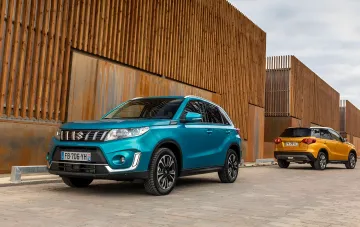
Compact crossovers firmly occupy an intermediate position between classic passenger cars and full-sized off-roaders — and this is precisely what drives their growing popularity. According to an RBC-Ukraine review, this particular segment is actively pushing traditional hatchbacks and "regular" family cars out of the market. Crossovers are typically built on a passenger car platform with a unibody frame and are primarily focused on comfortable operation on paved roads. At the same time, increased ground clearance, a higher seating position, and often a more spacious interior make them noticeably more versatile than sedans and hatchbacks of the same price range.
Urban Advantages That Aren't Visible on Paper
For the daily city dweller, a crossover is not just a "mini off-roader," but a set of practical benefits. Increased ground clearance and larger approach and departure angles allow drivers to confidently clear high curbs when parking. Larger wheels handle potholes and pavement damage better. A higher driving position provides a better view of traffic and makes getting in and out easier — which is crucial for short daily trips when the car must be exited multiple times a day. Finally, the compact dimensions of models in this class help maneuver through dense traffic and find parking spaces even on crowded streets.
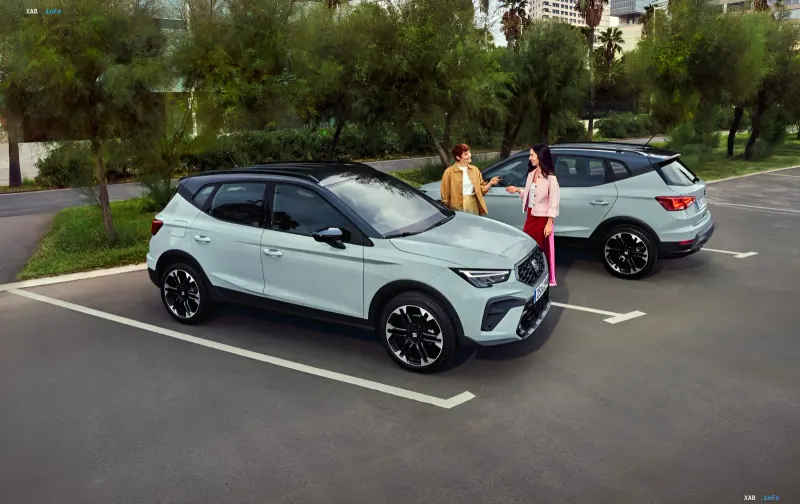
Seat Arona: The Sportiest in the Selection
If we define the role of each model, the Seat Arona stands out as the sportiest among compact crossovers. This is supported by the brand's "hot" image, the brisk engine sound, and quite adequate dynamics: acceleration from 0 to 100 km/h takes 8.2 seconds. The car is equipped with one of two petrol engines — a naturally aspirated 1.6 L with 110 hp or a turbocharged 1.0 L TSI with 116 hp. The transmission is exclusively automatic: either a classic hydro-mechanical automatic or a dual-clutch DSG. Drive is front-wheel only, which is a standard solution for the urban segment.
Dacia Duster: An Off-Roader Disguised as an Urban Crossover
The Dacia Duster is unquestionably the most off-road-capable vehicle in the selection, and perhaps beyond it. Unlike many competitors, the Duster doesn't just mimic off-road capabilities with its exterior; it genuinely retains them. All trims feature a ground clearance of around 217 mm, short body overhangs (approach angle 31°, departure angle 36°), and the 4×4 version is equipped with five all-wheel-drive modes. An important distinction of the Duster is its energy-absorbing suspension, which has been considered the benchmark for rough roads and broken asphalt across three generations. Ukrainian dealerships offer a 1.5 L diesel, a 1.3 L petrol, and a petrol-hybrid variant based on a 1.2-liter unit.
Opel: A Compact "German" with European Roots
The crossover from Opel is the most compact in the review (length 4,151 mm) and, according to the authors, the most "European" car of the selection: a typical "German" with a classic set of advantages and fashionable styling. The model cannot boast exceptional interior space, but it is precisely this compactness that makes it convenient for dense urban traffic. Overall, all five models in the review are front-wheel-drive (or simplified 4×4) crossovers that provide a sensible balance between price, efficiency, comfort, and functionality.
A Compromise That Works
Every crossover is the product of compromises, and the class has typical flaws: most compact models are not designed to tackle severe off-road conditions; the 4×4 transmission, if offered, is simplified and focused on improving traction on paved roads in difficult weather conditions. This helps reduce weight, price, fuel consumption, and maintenance costs. Nevertheless, the compact models gathered in this review demonstrate that this compromise works for the urban environment: a crossover offers the practicality of a passenger car with elements of off-road confidence, without requiring the budget of a full-sized SUV.