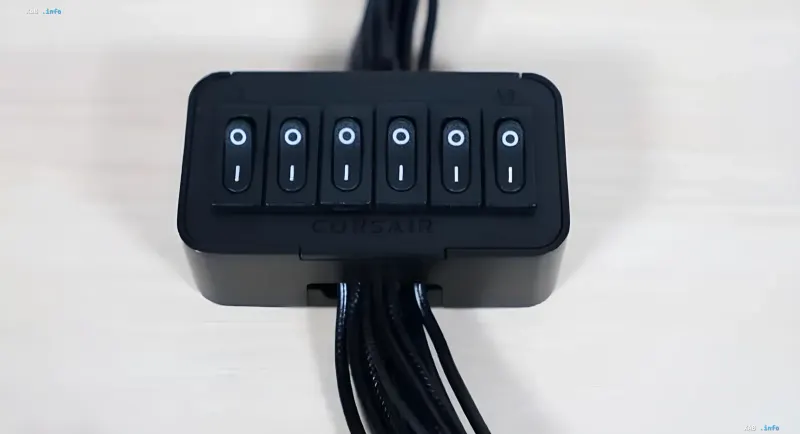
Corsair has launched a specialized 12V-2x6 power cable equipped with six independent physical switches. The device is designed for engineering tests of the PinProtect and PinProtect+ safety technologies, which are intended to prevent overheating and melting of graphics card power connectors under excessive load on individual pins. The photograph shows a compact black unit with the Corsair logo, where each of the six switches features "O" and "I" position indicators, allowing the operator to disconnect or connect a specific pin in real time.
Design and Operating Principle of the Test Cable
The cable architecture differs from standard power solutions for graphics accelerators. Located in the central part is a separate module with six lever switches, each controlling one of the six power contacts of the 12V-2x6 connector. Engineers can sequentially disconnect contacts, simulating connection degradation, oxidation, or total failure of individual lines. Meanwhile, the remaining active contacts absorb the increased electrical load, creating conditions closely approximating emergency operational scenarios for a graphics card in real-world environments.
Testing on the GeForce RTX 5080: The PinProtect Scenario
Practical verification of the device was carried out by specialists from the Spanish tech publication Profesional Review. An NVIDIA GeForce RTX 5080 graphics card paired with two Corsair power supply units served as the test bench. In the first scenario, the RM1200e Gen 2 model line equipped with basic PinProtect technology was used. With the graphics accelerator consuming approximately 250W, engineers sequentially disconnected contacts until only one of the six remained active. At this point, the PinProtect system detected a critical current excess on the single working contact and automatically cut off power to the graphics card, preventing potential connector damage.
Advanced Monitoring: PinProtect+ and the iCUE Software
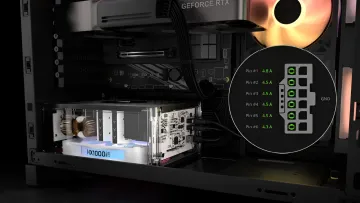
In the second experiment, the HX1000i SHIFT Crystal power supply, equipped with the more advanced PinProtect+ protection version, was deployed. The key difference of this technology lies in the continuous tracking of current on each of the six contacts via Corsair's proprietary iCUE software. During the test, when only two contacts remained active, the system recorded an excess of the established 9.5-ampere threshold. If the dangerous load persisted for 30 seconds, the power supply forcibly de-energized the graphics accelerator. This approach allows for not only reacting to instantaneous spikes but also identifying persistent overloads that might not cause immediate failure but gradually degrade contact groups.
Significance for the Market and Users
The appearance of a specialized test cable underscores manufacturers' growing focus on the reliability of the 12V-2x6 power interface, which has become the standard for high-performance RTX 50-generation graphics cards. Connector melting incidents recorded in the first months following the release of the new-generation accelerators stimulated the development of hardware and software protection mechanisms. Thus, Corsair is not only offering end users power supplies with built-in protection but is also creating tools to verify their functionality, enhancing overall trust in the technology and reducing the risk of expensive component failure.