
Four years ago, astronomers encountered a puzzle: strange long-period radio transients (LPT) began to be detected in space. The signals were found in a dozen sources, but their nature remained unexplained due to the scattered nature of the data. Each observation provided only a partial picture, preventing the construction of a coherent theory. However, a recent discovery of a new source, nicknamed the 'Rosetta Stone,' has united all the key 'clues,' finally allowing scientists to get closer to the solution.
From Ancient Hieroglyphs to Cosmic Signals
The name of the new object alludes to the famous Rosetta Stone found in Egypt. It was thanks to the inscriptions in three languages on this stone that ancient Egyptian writing was deciphered. The situation in astronomy turned out to be similar: the new LPT source possesses a complete set of characteristics that were previously observed separately in other objects. This allowed scientists to unite scattered events into a single class of phenomena and begin to understand their true nature.
What Lies Behind the Flashes
According to a recent publication in the journal Nature Astronomy, the new long-period radio transient, named ASKAP J1745−5051, was discovered using the Australian ASKAP radio telescope. The object demonstrates remarkable regularity: it produces a bright flash in the radio spectrum approximately every 81 minutes. Moreover, the same periodicity is observed in the X-ray range.
Powerful instruments were recruited for the detailed study of the object: X-ray data were provided by the Swift and Einstein Probe space observatories, while optical observations were conducted by the SOAR and Magellan telescopes.
A Binary System Instead of a Single Star
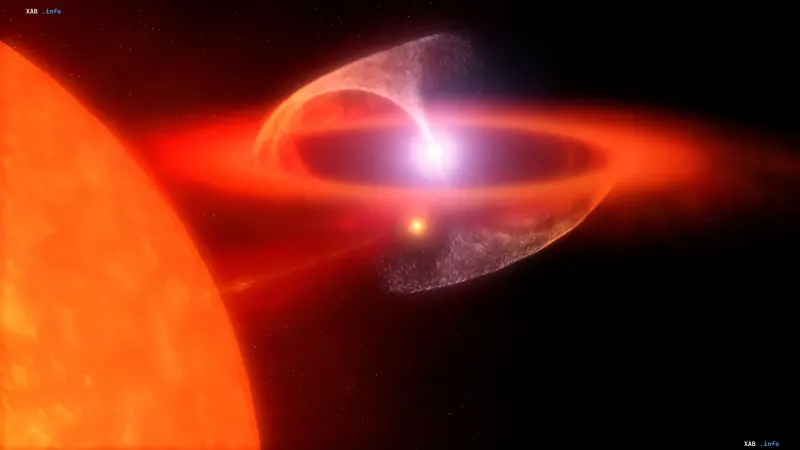
Observations in the optical range brought decisive clarity. It turned out that the source of the signals is not a single neutron star, as previously assumed, but a close binary system. It consists of a white dwarf and a red dwarf — its companion.
The mechanism of the system works as follows:
- The white dwarf gravitationally pulls matter from its companion — the red dwarf.
- The flow of matter falls onto the white dwarf, heating up to millions of degrees.
- This process becomes the source of powerful X-ray radiation.
- Directed radio bursts are likely born as a result of the interaction of the magnetic fields of the two stars and charged gas.
A New Benchmark for Science
The object was called the 'Cosmic Rosetta Stone' for a reason. For the first time, it combined several characteristics in one place: radio bursts, X-ray radiation, a binary structure, the presence of a white dwarf, the accretion process, and magnetic activity. Previously, these characteristics were found in different sources individually, which hindered scientists from linking them together.
This discovery does not mean that the nature of all long-period radio transients has been completely solved. However, astronomers now have a benchmark example. At the very least, some of the mysterious signals may be related not to super-slow pulsars, but precisely to magnetic binary systems with a white dwarf. Now, knowing what to look for, scientists will be able to check other LPT cases for similar characteristics, which will ultimately bring humanity closer to a full understanding of these cosmic phenomena.


