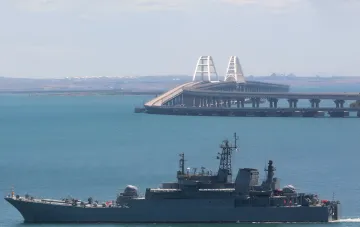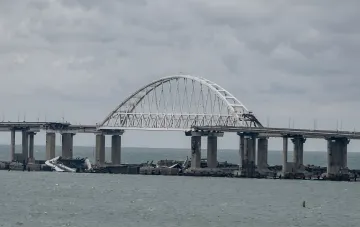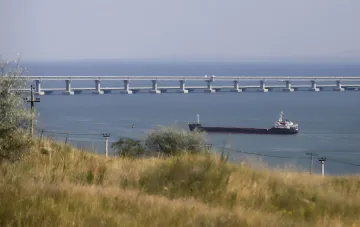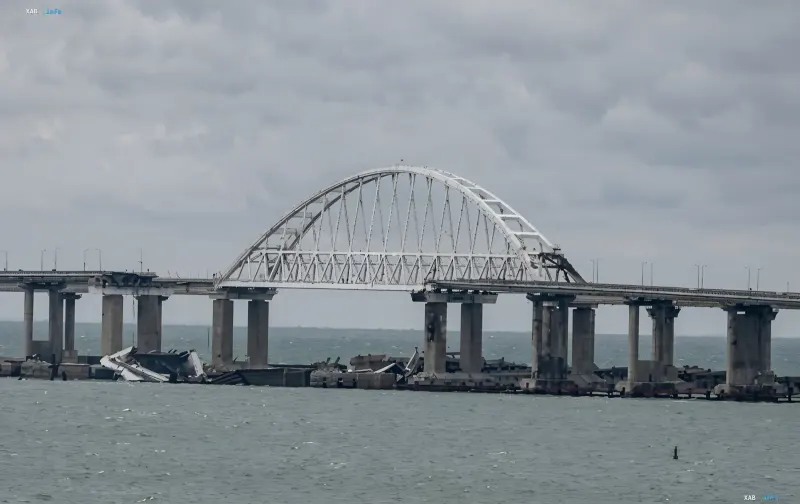
Over the past two days, the Crimean Bridge connecting the occupied peninsula to mainland Russia has been hit by massive Ukrainian strikes twice. As a result of the nighttime strikes on November 17, the arch and a span of the road section of the crossing collapsed into the water, blocking shipping in the Kerch Strait. The Russian Ministry of Transport confirmed the attack and announced the temporary suspension of traffic on both the road and railway sections; the occupation “head” of Crimea, Sergey Aksyonov, urged residents to refrain from traveling toward the bridge. Railway traffic was resumed by noon on November 17.
The Seventh Phase of a Multi-Stage Operation
President Volodymyr Zelenskyy confirmed that the attack was the culmination of a multi-stage joint operation by the SBU and the General Staff of the Armed Forces of Ukraine that had been in preparation for several weeks. According to him, this is the seventh phase of the operation, during which Ukrainian fighters systematically knocked out Russian air defense systems, radars, and electronic warfare assets on the approaches to the facility. Drones and missiles including Dovbush, Vendetta, Da Vinci, Sichen, MICH 2000, Ruta, Palyanytsia, An-197, FP-1, FP-5 Flamingo, and R-360 Neptune were used for the strike. Meanwhile, the SBU reported that the agency carried out part of the strikes on the bridge independently, as stated by service spokesperson Artem Dehtiarenko.
What the Parties Confirm
The General Staff of the Armed Forces of Ukraine reported that powerful explosions rang out over the strait, the arch and the road span collapsed, the road section is “dead” and no car will cross it, while the railway line is still standing, albeit with a damaged arch. Russian state television channels ignored the collapse in their morning broadcasts, reporting only on the alleged “repulsion” of a massive nighttime attack. The Kremlin reported that the government briefed Vladimir Putin on the situation; he flew out on a visit to China in the morning and did not comment publicly on the incident. Instead, spokesman Dmitry Peskov promised that “the Crimean Bridge will be restored” and “will be even better than before.”
Blocking the Kerch Strait
Captain 1st Rank (ret.) of the Ukrainian Navy, military expert Andriy Ryzhenko, assessed the damage to the crossing as moderate and believes that the restoration of the destroyed road span with the arch will take more than a year. The main strategic effect, according to him, is the blocking of shipping: a metal structure weighing about 6,000 tons and about 45 meters high fell directly into the fairway of the Kerch Strait. The expert suggested that it will most likely be dismantled and disposed of through underwater explosions, and for this period the strait will be closed to Russian and occupied Ukrainian ports — “at least weeks, possibly months.”
A Blow to Logistics and the Black Sea Fleet
The consequences of the attack create a critical problem for the Russian Black Sea Fleet, which will be unable to receive reinforcements of naval vessels, for example from the Caspian Flotilla or Azov, for several months. According to Ryzhenko's estimate, by losing this route, Ukraine will deprive the occupiers of a quarter to a third of their military logistics. The main flow of cargo to the south is currently directed by Russians via the overland Pryazovia corridor (M-14 highway) along the Rostov-on-Don — Mariupol — Berdyansk — Melitopol — Henichesk/Dzhankoi route, but this route is also under the fire control of the Ukrainian Defense Forces. The General Staff of the Armed Forces of Ukraine added that after the destruction of the bridges across Chongar and in Henichesk, the occupiers have fewer and fewer overland routes to Crimea, and every hour of downtime of the Crimean Bridge deprives the Russian grouping in the south of necessary resources — fuel, ammunition, equipment, and personnel.
Can the Bridge Be Finally Destroyed?
Denys Shtillerman, co-founder of the defense-tech company Fire Point, stated back in April 2026 that Ukraine cannot completely destroy the Crimean Bridge, but is capable of regularly destroying it. Thus, even with partial damage and the restoration of individual sections, the crossing remains a vulnerable target, and its periodic disabling continues to damage the military logistics and fleet of Russia in the southern direction.