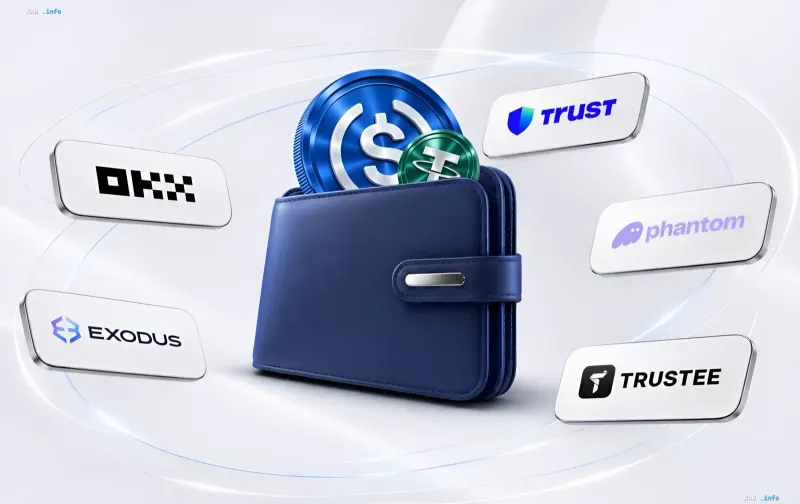
"We can settle in USDT" is a phrase that should remain simple for the recipient: accept the payment, keep part of it on the balance, exchange or transfer the rest without turning every action into a separate task. This is precisely where crypto wallets differ significantly. Some focus on everyday transactions, others offer freedom in choosing networks, and a third group provides tools for more active cryptocurrency work or a full-fledged computer application. RBC-Ukraine compares five wallets for receiving USDT and USDC in its selection, evaluating ease of use, supported networks, and features that come in handy after funds arrive. After all, a wallet's convenience does not end with a new payment notification.
Trustee Plus: a wallet for regular transactions
In the selection, Trustee Plus takes a leading position due to its combination of features necessary for regular transactions: receiving USDT and USDC, exchanging, and transferring are gathered in a single app. This approach is especially convenient when stablecoins arrive as payment for work or transfers from loved ones and need to be used throughout the month. The app does not limit receiving stablecoins to a single network: Ethereum, BNB Smart Chain, and Polygon are available, among others, and USDT can also be received via Tron. This allows accepting payments from people using different wallets and exchanges.
Among practical features are in-service transfers: another user can be found by phone number, ID, or nickname, and according to company information, such operations are instant and fee-free. If you need to transfer part of the funds to a family member who also uses Trustee Plus, there is no need to exchange long addresses. Exchange is available directly within the app, so a separate exchange account is not required. For beginners, support with live operators is provided right from the app, along with a payment card supporting Apple Pay and Google Pay, on whose balance received USDT or USDC can be directed for everyday purchases.
Trust Wallet: wide network choice and fee payment with stablecoins
Trust Wallet attracts attention primarily with its wide network choice: it supports over a hundred blockchains, including Ethereum, Tron, Solana, and BNB Smart Chain. For receiving stablecoins, this is useful when there are multiple payers and each has their own transfer habits: if one client settles in USDT via Tron and another sends USDC via Solana, both payments can be accepted through a single wallet. Capabilities are not limited to receiving funds—the wallet features token swapping and connection to decentralized services.
Special attention goes to the FlexGas feature: in supported operations, it allows paying network fees in USDT or USDC, which simplifies the further use of received funds since you do not always have to separately top up your balance with a coin for fees. However, this feature is not available in all networks and scenarios. Trust Wallet has a mobile version and a browser extension, making it suitable for a user who is only receiving payments today but wants more capabilities for the future.
Exodus: a scenario for working on a computer
Exodus is worth considering for those who spend most of their working day at a computer: it has a full-fledged desktop program as well as a mobile app. Checking fund arrivals, viewing previous operations, or copying an address for a client can be done on the same device where correspondence is conducted. Mobile and desktop versions can be synchronized to access a single wallet, eliminating the need to keep a separate balance on the phone and transfer funds to yourself just for changing devices. Exodus supports USDT and USDC across multiple networks: for USDT, Tron, Ethereum, and Solana are available; for USDC, Ethereum and Solana.
What to look for when choosing a wallet
The composition of the RBC-Ukraine selection featured in the material also includes OKX and Phantom wallets, which appear among the five solutions considered. When choosing, you should focus on three criteria named by the publication: ease of use, the set of supported networks, and tools that come in handy after funds arrive. If the priority is everyday transactions and transfers to loved ones, it is logical to look at wallets with internal transfers and a payment card; if it is important to accept payments from different networks, the number of supported blockchains becomes decisive; if work is conducted mainly on a computer, a desktop version with synchronization becomes an advantage. In any case, a wallet's convenience is determined not by the moment of receiving the payment, but by how easy it is to use the funds immediately after.