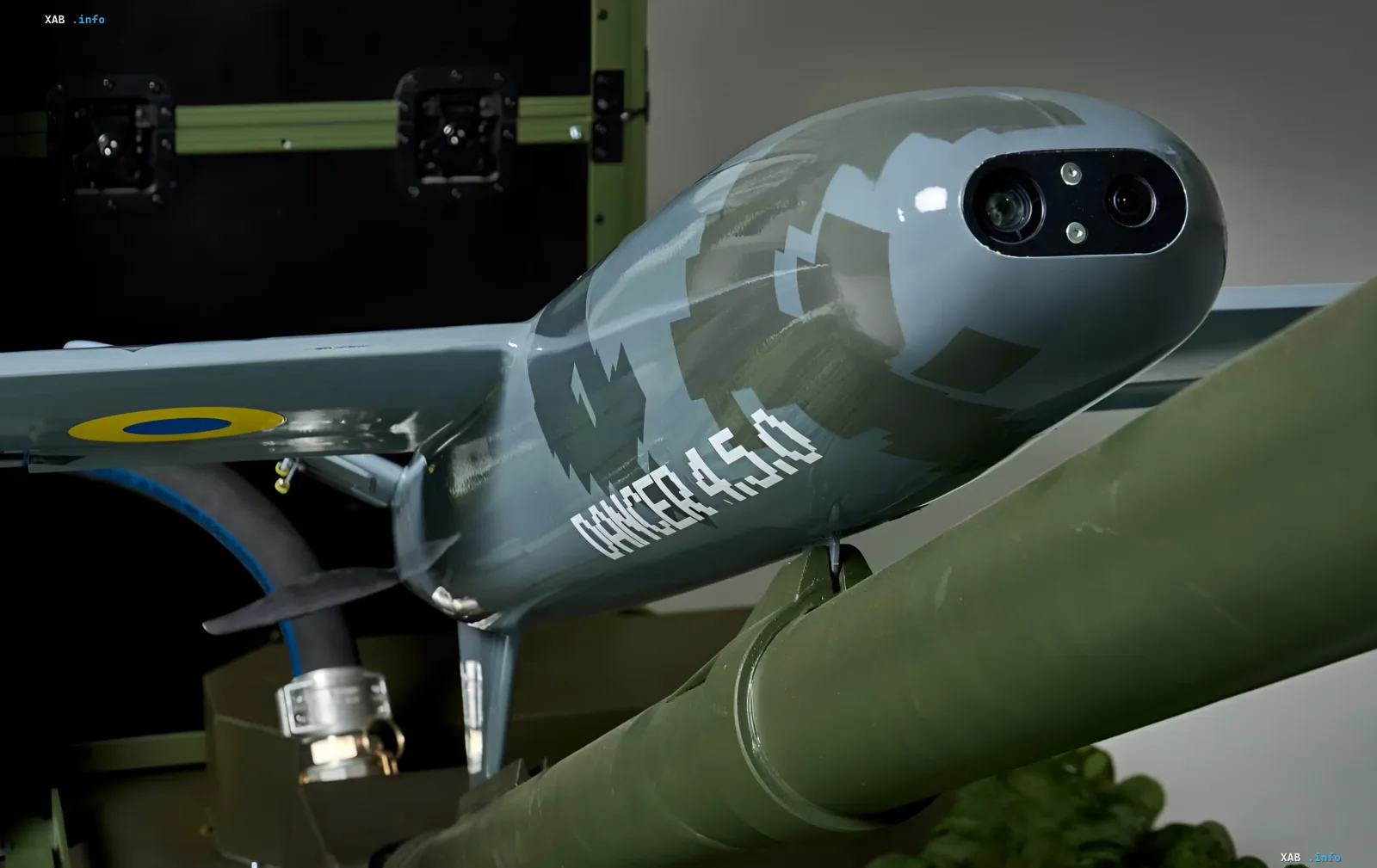
On the battlefield, where speed and precision are everything, the Ukrainian company Yartura has unveiled a new technological breakthrough — the Dancer 4.5.0 interceptor drone. This is not just another unmanned aerial vehicle: it is an autonomous system powered by artificial intelligence, capable of independently locating, tracking, and engaging targets even under conditions of electronic warfare jamming.
Speed, Altitude, Autonomy
The Dancer 4.5.0 accelerates to 450 km/h — a figure that places it on par with combat aircraft. Its maximum engagement altitude reaches 4.8 km, with an operational range of up to 30 km. But the key lies not in the numbers, but in how the drone operates.
The system is equipped with an Automatic Target Tracking System (ATTS). If the first approach fails, the drone does not abandon the mission — it returns, recalculates its trajectory, and attacks again. All of this occurs without operator intervention, thanks to an AI-based autonomous targeting module.
Fewer People — Greater Efficiency
High levels of automation fundamentally change the logic of operating military hardware. The minimum crew for the complex consists of just three people: a pilot, a gunner, and a driver-sapper. Moreover, a single operator can simultaneously control multiple drones via LTE-based command systems.
This reduces personnel workload, accelerates crew preparation, and simplifies the deployment of new positions. In modern warfare, where time is a critical resource, such solutions become not merely convenient, but essential for survival.
Context: From Procurement to New Weaponry
The unveiling of the Dancer 4.5.0 comes amid sweeping changes in the procurement system for drones used by the Armed Forces of Ukraine. RBK-Ukraine previously reported on the creation of a specialized defense marketplace, DOT-Chain Defence, enabling faster and more transparent acquisition of equipment from domestic manufacturers.
At the same time, Ukraine is finalizing the development of its first indigenous glide bomb, “Vyravnyuvach” — a project that took nearly a year and a half to complete. These steps reflect a systematic approach to modernizing the armed forces: from tactical innovations to strategic platforms.
Technology as a Factor of Survival
The Dancer 4.5.0 is more than just a drone. It represents a new paradigm: one in which machines think, make decisions, and act autonomously, while humans remain controllers rather than executors. In conditions where adversaries actively employ electronic warfare and stealthy targets, the drone’s ability to independently identify and engage objects becomes a decisive advantage.
Yartura has not merely created hardware — it has proposed a new way of waging war. If such systems are deployed at scale, the balance of power in the air could shift dramatically.


