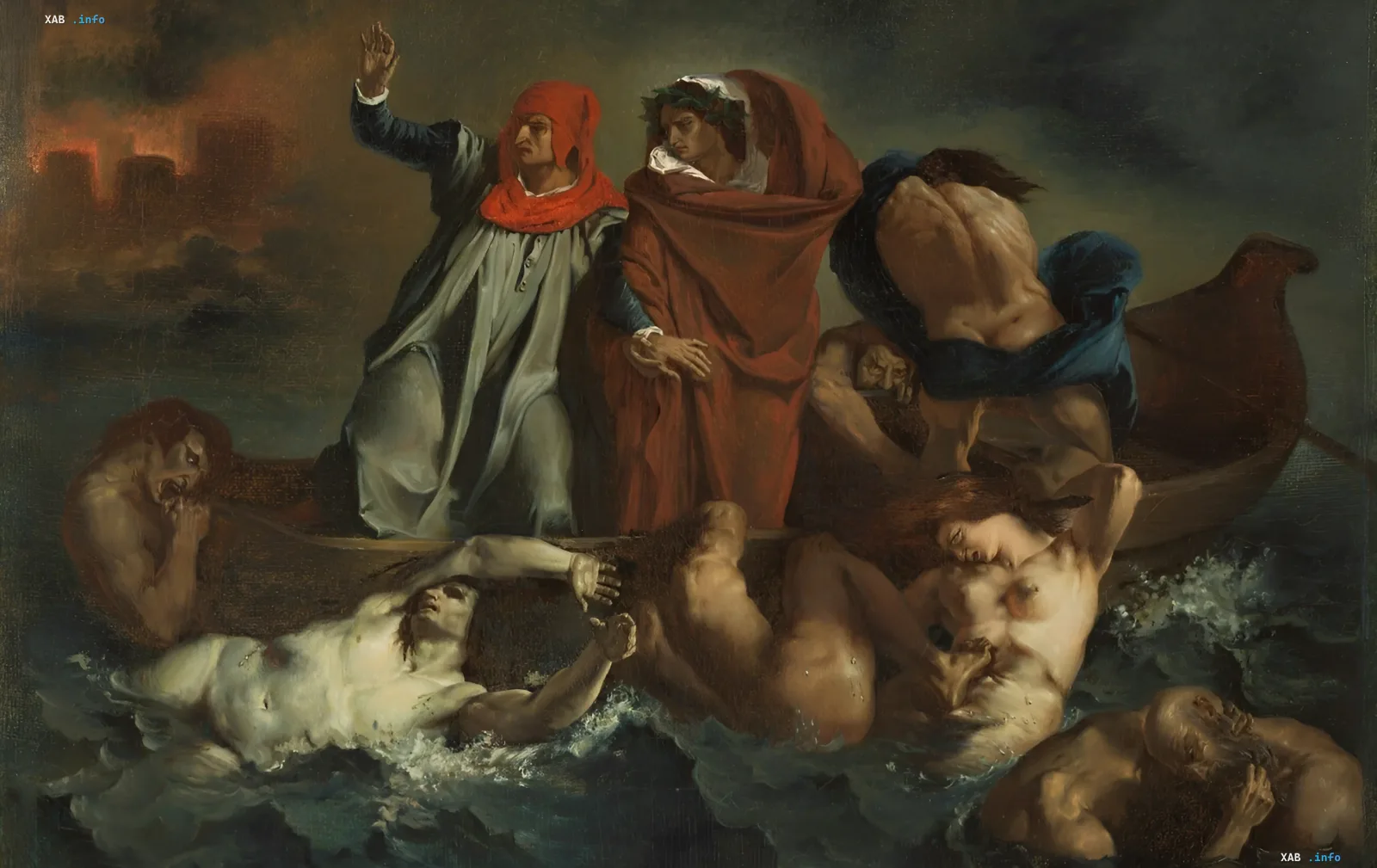
Seven hundred years ago, the Italian poet Dante Alighieri described the structure of Hell, which, according to a new scientific hypothesis, may not be a metaphor for sins but an accurate description of a cosmic catastrophe. Researchers suggest that the famous 'Divine Comedy' contains surprisingly precise details of a collision between Earth and a giant asteroid.
Satan as a Cosmic Impactor
Traditionally, the fall of Lucifer from the heavens in the poem was interpreted exclusively as a spiritual event. However, Professor Timothy Burberry from Marshall University put forward a bold theory, which he presented at the European Geophysical Union General Assembly (EGU General Assembly 2026). In his opinion, Dante described Satan not as a mythical creature, but as a physical high-speed object — a cosmic impactor.
According to impact physics modeling, the trajectory of Satan's fall completely matches the fall of a large asteroid, similar to the interstellar object 'Oumuamua. The body pierces the southern hemisphere and penetrates to the very heart of the planet.
Geophysics instead of Theology
According to the model, an impact of such force displaced colossal masses of the Earth's crust, pushing the northern hemisphere upwards. As a result, a giant funnel was formed, narrowing towards the planet's core — exactly how Dante depicted the topography of Hell. Moreover, the rock displaced by the shock wave behind the impactor rose from the ocean, forming the Mountain of Purgatory. This perfectly corresponds to the concept of a 'central peak,' which always forms in the epicenter of impact craters.
Researchers compare the scale of the described catastrophe with the fall of the Chicxulub meteorite, which led to the extinction of the dinosaurs. However, unlike Chicxulub, the cosmic body in the poem did not evaporate but got stuck in the core, retaining its structure, reminiscent of the famous 60-ton iron Hoba meteorite.
Nine Circles as Terraced Rings
The new interpretation fully explains the structure of the nine circles of Hell. Instead of symbolic levels of sinfulness, they surprisingly accurately copy the concentric terraced rings that form in massive impact basins throughout the Solar System. Similar multi-ring structures are recorded by modern astronomers on the Moon, Venus, and other celestial bodies after collisions. Dante intuitively described these geomorphological features long before science understood the mechanics of their formation.
Scientific Foresight of the Middle Ages
The text of the 'Divine Comedy' contains references to phenomena that are now known as terminal velocity, penetration through the Earth's crust, and maximum compressive stress of materials at the core. The poet also applied elements of non-Euclidean geometry in the 'Paradiso' part, describing the distortion of space.
Dante recognized meteorites as a real geological force in an era when the dogmas of Aristotle about 'ideal and unchanging heavens' prevailed. The physical depiction of the catastrophe helped Western thought move away from perceiving space as a purely spiritual illusion.
Modern scientists note that such medieval texts and geodata can help planetary safety specialists better calculate the cyclicity and consequences of global cosmic threats to Earth. The discovery proves that ancient literature and myths often record and preserve observations of real natural threats even before science finds a formal explanation for them.


