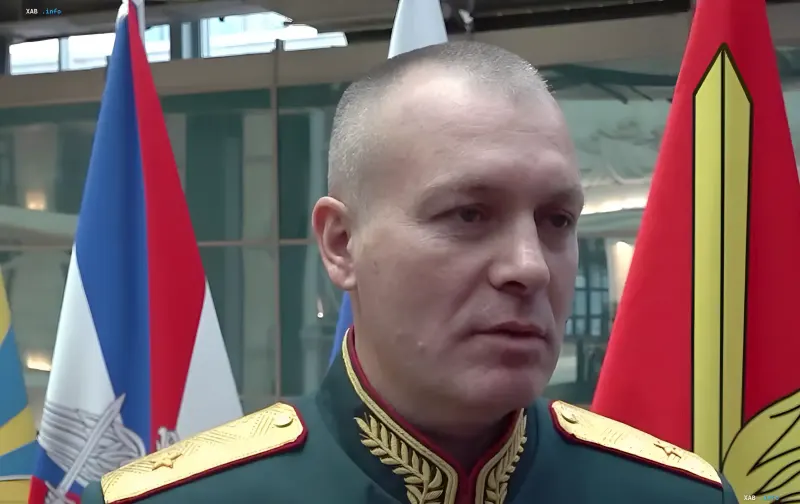
On September 16, 2026, it was reported that Russian Major General Anton Grunis, commander of the 4th Separate Guards Motorized Rifle Brigade, callsign 'Groznny' (Fierce), had died. This was announced in his Telegram channel by Apti Alaudinov, Deputy Head of the Main Military Political Directorate of the Russian Armed Forces and commander of the 'Akmat' special forces unit, who stated that Grunis 'has passed into another world.' Information about the general's death was also spread by Russian Z-blogs and the community of graduates of the military school he attended. The exact circumstances and location of Grunis's death were not disclosed by either side at the time of publication.
'Golden Star' for Konstantinovka
Grunis's death gained significant resonance against the backdrop of the fact that just weeks before his death he had been awarded the title of 'Hero of Russia.' According to available data, in early July 2026 it was this very Major General who personally reported to Vladimir Putin the alleged 'capture' of Konstantinovka in Donetsk Oblast. It was after this report that he was awarded the highest military honor. Thus, less than two months passed between the awarding of the 'golden star' and the general's death — a period during which, according to the Ukrainian side, Konstantinovka was never placed under full control of Russian forces.
Konstantinovka: between the report and reality
As of September 16, 2026, Konstantinovka in Donetsk Oblast remains an area of active combat operations and is not under full Russian control. According to the General Staff of the Ukrainian Armed Forces, 18 attacks by Russian units were recorded on the Konstantinovka direction over the past 24 hours. The occupiers carried out assault operations in the areas of Konstantinovka and Ilyinivka, as well as in the directions of Osykove, Mykolaivka, Novohryhorivka, and Dolyha Balka. Ukrainian military previously reported that Russian units are attempting to penetrate the city through the flanks: some enemy groups had already entered Konstantinovka, however Ukrainian units continue to hold positions in the south, center, and north of the city, engaging in combat there. The Ukrainian side characterizes the situation as 'very difficult.'
Contradictory data
Assessments of the degree of Russian control over Konstantinovka vary significantly depending on the source. French OSINT analyst Clément Molén estimated Russian control over the city at approximately 50 percent. At the same time, the DeepState map as of early September 2026 showed only a small area under Russian control, while designating a significant part of the city as a 'gray zone.' Thus, Grunis's report to Putin about the 'capture' of Konstantinovka in early July is not confirmed by any independent or Ukrainian source monitoring the situation on the ground. Moreover, there is a discrepancy in the wording of the causes of the general's death: the official Russian statement by Alaudinov uses the euphemism 'passed into another world' without indicating combat circumstances, whereas Ukrainian media outlets (in particular, KP.ua) directly report his elimination by Ukrainian Armed Forces and add the claim of 'a tip-off from his own side,' which has not been confirmed by either side with documentary evidence.
Military context: Ukrainian offensive in Donetsk Oblast
Grunis's death comes against the backdrop of ongoing combat operations in Donetsk Oblast, where, according to Ukrainian sources, the Ukrainian Armed Forces managed to advance in several sectors over the preceding days. New details of the offensive operations by Ukrainian units in this region are emerging. The death of the general who reported the 'capture' of a city that was in fact not taken intensifies the discussion about the gap between the Kremlin's official military rhetoric and the real situation on the front.