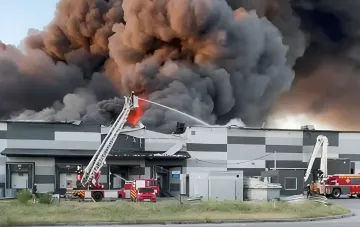
On the night of September 10, 2026, Russian military forces carried out a third strike on Dnipro within 24 hours, setting fire to food warehouses. This was announced by Alexander Hanza, head of the Dnipropetrovsk Oblast Military Administration (OMA), whose statement is cited by RBC-Ukraine. According to him, information on casualties was still being verified at the time of publication. The incident was part of a series of attacks that struck several settlements in Dnipropetrovsk Oblast over the course of the day.
Fire at food warehouses
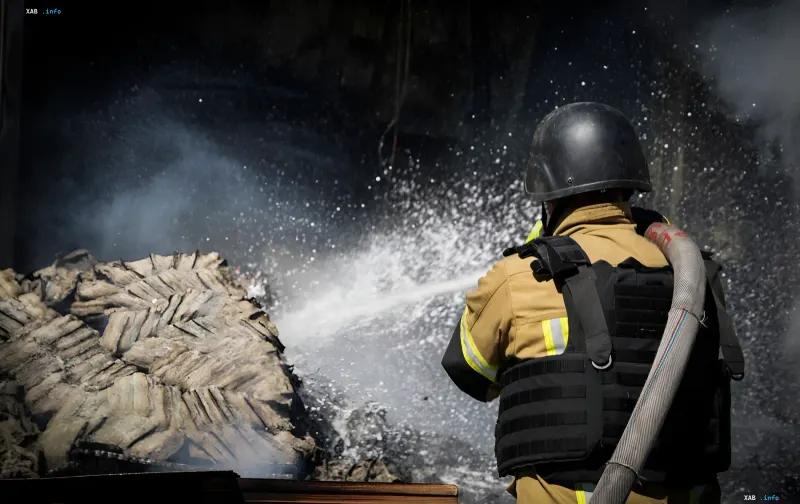
The target of the third strike of the day was food warehouses located in Dnipro. A fire broke out after the impact, as visual evidence shows: footage depicts a firefighter in protective gear directing a stream of water onto burning wooden structures, piles of charred materials, and thick plumes of smoke. As of the time information was received from authorities, data on casualties or injuries resulting specifically from this episode had not been fully confirmed — Hanza emphasized that the details were still being verified.
Bunge plant back in the crosshairs
Earlier the same day, Russian occupiers struck the "Oleina" plant, owned by the American multinational corporation Bunge, with an unmanned aerial vehicle. Dnipro Mayor Borys Filatov noted that the facility is located in the central part of the city and has become the target of Russian attacks for the first time. Later, Bunge's press service told RBC-Ukraine that the "Oleina" plant had suspended operations due to the consequences of the Russian strike. The repeated hit on a facility linked to a foreign investor once again underscores the systematic nature of the attacks on the city's industrial infrastructure.
Attack on Pavlohrad: four killed and over 60 injured
In addition to the strikes on Dnipro, Russian military forces attacked the "Gulliver" shopping center in Pavlohrad on the same day. A fire broke out in the building as a result of the impact. According to available data, four people were killed and more than 60 were injured in this attack. Among the injured were three children: boys aged 13, 14, and 15. The large-scale loss of civilian lives, including minors, indicates that strikes on civilian infrastructure continue to be part of Russian tactics.
Contradictory data
There is a discrepancy between various sources regarding the number of strikes on Dnipro within 24 hours. Alexander Hanza and RBC-Ukraine report a third strike of the day, while the publication "Pravda," in an article dated September 10, 2026, cites four attacks over the course of the day. This may be due to the fourth strike being recorded after Hanza's statement, or to differences in counting methodology (for example, splitting a single salvo into several episodes). In addition, data on casualties also varies: in one of "Pravda's" publications dated September 2, 2026 (referring to an earlier episode), two killed and eight injured were reported in Dnipro, whereas the attacks of September 10 in Pavlohrad resulted in four killed and over 60 injured. These figures relate to different locations and time frames, which requires careful interpretation.
Authorities' response and context
The series of strikes on September 10, 2026, demonstrates a persistent trend of multiple attacks on the same infrastructure within a short period of time. The repeated hit on the Bunge plant, the strikes on food warehouses, and the attack on a shopping center with mass civilian casualties paint a picture of deliberate pressure on the economic and social facilities of Dnipropetrovsk Oblast. Local authorities continue to verify information on casualties, while the enterprises that became targets of the attacks are forced to suspend operations.