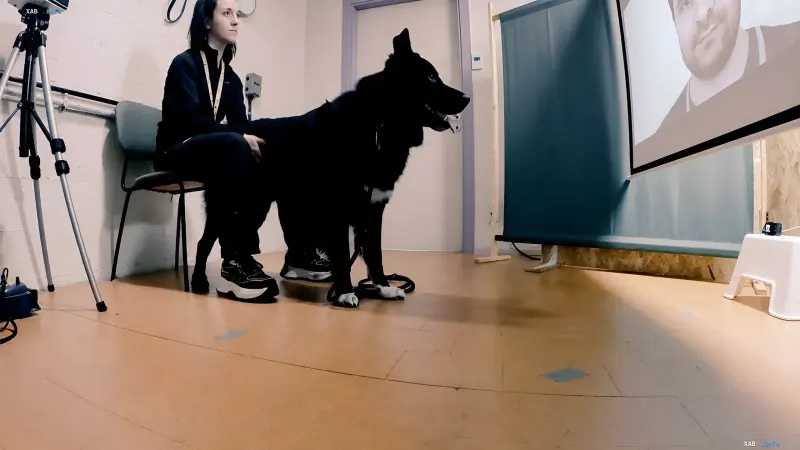
Anyone who has ever held eye contact with their dog has probably noticed it: the pet blinks back softly and frequently, as if answering an invisible question. For a long time, this was considered a random physiological reflex — the same one that keeps the eye's mucous membrane moist. However, a new study by researchers at the University of Parma (Italy), published in the peer-reviewed journal Royal Society Open Science, has turned this view on its head: blinking in dogs is a deliberate social tool, a subtle 'communication channel' with humans that pets use selectively and only with those they trust.
What the experiments actually showed
The key finding of the study is that dogs begin to blink more often when they see a person in front of them doing the same. But a crucial detail matters: this effect appears exclusively in response to the owner's face. Dogs barely reacted to the blinking of strangers, ruling out the idea of a universal, 'automatic' reaction. Moreover, the researchers recorded that the blinking rate increased even more when the dog's owner was a woman. In other words, the pet is not simply copying the movement — it is reading the context and the recipient.
It is important to stress that this is not blind mirror copying. The experiment showed that dogs do not have a direct reflexive reaction within 1.5 seconds after a human blinks, as happens with contagious yawning. The increased blinking rate is interpreted by the authors as a marker of heightened attention, emotional engagement, and an attempt to strengthen the social bond with the dog's 'primary' human.
The evolution of the 'puppy gaze'
To understand why blinking became so significant, we need to look into the species' evolutionary past. Wild wolves and other predators perceive a direct, steady stare as a threat or a challenge to fight. During the process of domestication, which lasted more than 15,000 years, dogs had to radically restructure their body language in order to survive alongside humans. Earlier, researchers in Pennsylvania found that, unlike wolves, dogs developed unique 'fast' muscles around the eyes and eyebrows — precisely these muscles allow them to make the famous 'puppy eyes' that trigger a surge of oxytocin, the so-called attachment hormone, in humans.
Even more important is the backstory of the discovery itself: in 2025, the same research group led by Chiara Canori proved that dogs 'blink at each other.' Within a pack, mutual blinking serves as a signal of peacefulness and trust — a silent message meaning 'I am not aggressive, I trust you.' The new study showed that dogs have transferred this same 'code' to their relationships with humans, adapting an intraspecific ritual for interspecies communication.
The interspecies 'blinking' club
Dogs are not alone in this skill. Scientists note similar patterns in other animals living alongside humans: cats respond to a slow narrowing of the eyes (the so-called Duchenne smile), perceiving it as a sign of safety; horses read the tension around a person's eyes — their heart rate increases if they see an angry face in a photograph; cows remember friendly facial expressions and subsequently tend to stay closer to 'friendly' people. All these examples point to the fact that reading facial expressions and eye language is a widespread adaptation to coexistence with humans.
Contradictory data
Here it is important to honestly distinguish between two positions that arise in the scientific discussion around this discovery. The study's authors emphasize that blinking is an element of social interaction and emotional connection, i.e. a functional 'language' between species. At the same time, an independent commentator, Dr. Laura Quaya of the University of Vienna, warns against excessive anthropomorphism: in her words, one should not think that every individual dog 'wink' is an encoded message or conscious speech. Thus, the difference lies not in the observations themselves but in the degree of intentionality: some see in blinking a deliberate communicative act, while others see it more as a barometer of comfort and engagement that does not require a 'verbal' translation. Both viewpoints agree on the main point: blinking carries social meaning, but its interpretation as 'speech' remains a subject of cautious debate.
A practical takeaway for owners
For everyday life, the discovery offers a simple guideline: a dog's blinking is an indicator of its comfort and trust. If your pet is sitting in front of you and softly, frequently blinks while looking at your face, this is the equivalent of a polite nod, a warm smile, or the phrase 'we are on the same wavelength, I hear you and fully trust you.' The practical recommendation from the study is this: next time you catch your dog's gaze, do not stare at it intently — simply blink back softly. This is not manipulation, but a response to the same social signal that your pet already uses to strengthen the bond with you.