
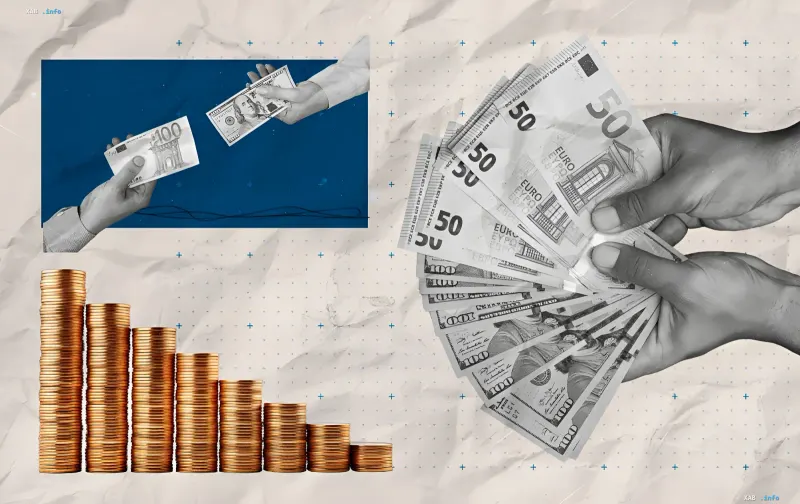
The foreign exchange market at the beginning of July demonstrates a steady trend of declining value for major foreign currencies. The National Bank of Ukraine (NBU) officially fixed a decrease in the value of both the US dollar and the euro on July 2. Experts note that under current conditions, panic buying of cash may be less profitable than a smart diversification of assets.
Official Exchange Rates: Dollar and Euro Lose Ground
According to the regulator, the official exchange rate of the US dollar on July 2 was 44.76 hryvnias. This is 3 kopecks lower than the previous banking day, when the dollar cost 44.79 hryvnias. The European currency also continued to decline: the euro rate was set at 50.97 hryvnias, which is 6 kopecks less compared to the rate on July 1 (51.03 hryvnias).
Thus, at the beginning of the month, a gradual decrease in the value of both key currencies relative to the national currency is observed.
Savings Strategy: Why "All or Nothing" Is a Mistake
Against the backdrop of the ongoing war, the question of preserving the value of savings remains one of the most pressing for citizens. Serhiy Mamedov, Vice President of the Association of Ukrainian Banks and Chairman of the Board of "Globus Bank," warned against extremes in personal budget management in a comment to RBC-Ukraine.
The expert emphasized that thinking in terms of "either all in foreign currency or all in hryvnias" is strategically incorrect. The most reasonable approach in the current situation remains diversification:
- It is indeed advisable to keep part of the funds in foreign currency as a reserve. This is financially justified for creating a safety cushion in case of unforeseen circumstances.
- However, buying currency solely against the background of rumors and fear is not the best investment strategy.
Hryvnia Deposits vs. Passive Currency Storage
The specialist drew attention to the attractiveness of hryvnia deposits, driven by the high discount rate of the NBU. At the moment, average deposit rates start from 14% per annum, while the maximum bank offers reach 16.5–17.5%.
Mamedov provided a specific profitability calculation: if you place 100,000 hryvnias in a deposit at 14% per annum for six months, the net income after tax payments will be about 5,400 hryvnias. For the purchase of dollars to yield a similar result, the rate of the American currency must rise to 47.4 hryvnias. When using higher deposit rates, the break-even threshold for buying currency rises to almost 48 hryvnias per dollar.
The expert's conclusion is unambiguous: if the weakening of the hryvnia occurs gradually, without sharp jumps, placing funds in a deposit may turn out to be more profitable than simply holding cash currency.
Optimal Financial Management Model
According to the banker, the most balanced solution is a combination of various financial instruments. The optimal savings model includes:
- Placing part of the funds in hryvnia deposits or in internal government bonds (OVGZ).
- Keeping part of the capital in foreign currency.
- Maintaining a certain stock of cash and funds on current card accounts for operational expenses.


