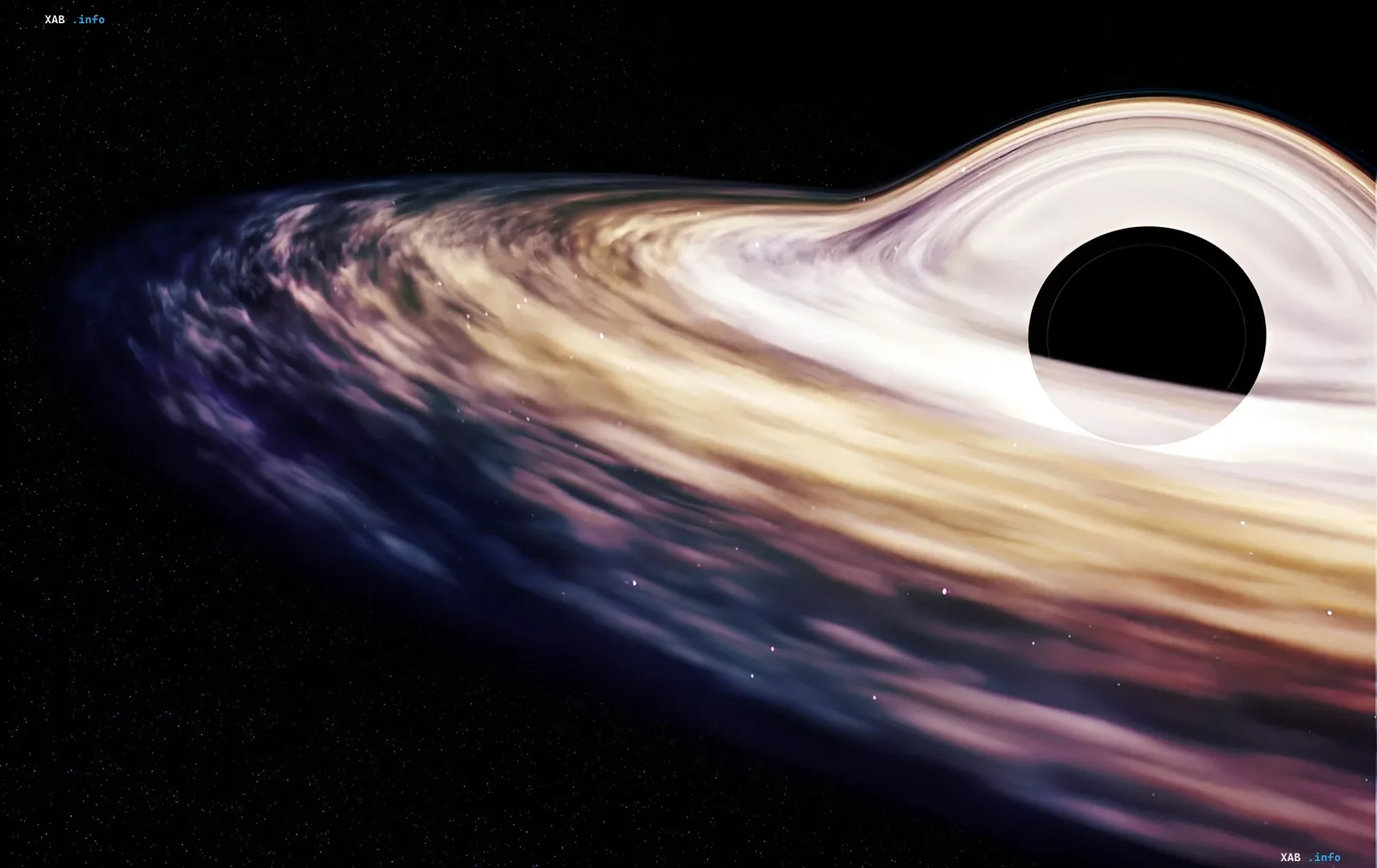
Astronomers have made a discovery that will revolutionize our understanding of the dynamics of active galactic nuclei. An international team of researchers has confirmed that the source of the most powerful radiation in the galaxy Markarian 501, located 500 million light-years away, is not a single supermassive black hole, but a binary system.
The results of the study, published in the prestigious journal Monthly Notices of the Royal Astronomical Society, shed light on the mysterious behavior of this object. The Markarian 501 galaxy is known as a blazar — one of the brightest and most energetic objects in the Universe. Such systems are powered by supermassive black holes that eject narrow beams of high-energy radiation into space, called jets.
The mystery of strange behavior
For a long time, astronomers could not explain the strange dynamics of the jet in this galaxy. Its orientation changed in an unpredictable manner, which did not fit into the classical models of a single black hole's behavior. To solve the mystery, specialists from the Max Planck Institute for Radio Astronomy conducted a large-scale analysis of data.
Researchers studied more than 83 observation arrays obtained by the international network of radio telescopes, the Very Long Baseline Array. A detailed analysis showed that what was perceived as one complex structure is actually composed of two separate jets. The second one curls into a counter-clockwise loop around the center of the system.
This observation became key evidence: each jet is powered by a separate giant black hole. The mass of each of these cosmic monsters is colossal — from 100 million to 1 billion solar masses.
The perfect Einstein ring
The theory of the system's binary nature was finally confirmed by a unique event recorded in June 2022. At that moment, the cosmic giants aligned in a perfect line relative to Earth. The immense gravity of the first black hole bent the light from the second jet, creating a gravitational lens effect.
In the images, this appeared as a practically perfect circle, known as an Einstein ring. This phenomenon became irrefutable proof of the presence of a pair of objects, rather than a single source of radiation.
Inevitable finale in a century
Currently, the black holes are at an astronomically close distance from each other. They complete a full orbit approximately every 121 days, moving clockwise. The distance between them is from 250 to 540 astronomical units (the distance from Earth to the Sun).
According to scientists' calculations, the process of approach is relentless. The collision and merger of these giants into one supermassive black hole will occur in less than 100 years. This event will become a catalyst for a colossal release of gravitational waves — powerful oscillations in the very fabric of space-time.
The strength of these waves will significantly exceed the indicators of any similar phenomena previously recorded by humanity. Existing and future space detectors on Earth will be able to clearly detect this signal. For science, this will be a unique opportunity to study in detail the nature, evolution, and internal properties of supermassive black holes at the moment of their final merger.


