
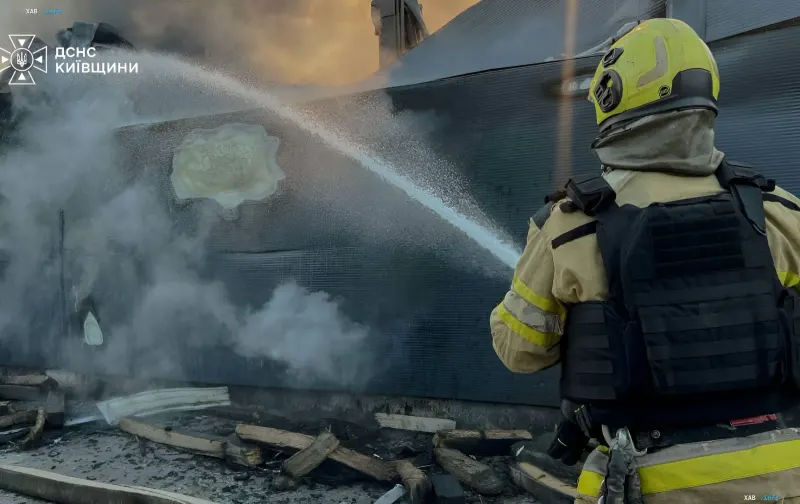
On September 2, 2026, Kyiv and the Kyiv region were once again hit by a massive attack by unmanned aerial vehicles. From the morning, fires broke out in several districts of the capital; residential buildings, a medical facility and, particularly alarmingly, a university in which classes were in session at the time of the strike were damaged. According to the Kyiv City Prosecutor's Office, at least nine people have been injured as a result of the attack. Emergency services are working at the impact sites, and vehicle traffic has been temporarily restricted in the city center.
Impact on a residential building and medical facility in Shevchenkivskyi district
The most serious consequences were recorded in the Shevchenkivskyi district. As Kyiv Mayor Vitali Klitschko reported, a UAV impact on a six-story residential building caused partial destruction of the structure and a fire. A nearby three-story building also caught fire. In addition, a medical facility in the same district was damaged: part of the windows in the premises were blown out. According to preliminary data from the mayor, there were no injuries among the patients and staff of the medical facility. As of noon, Klitschko reported seven injured, five of whom were hospitalized. Later, the Kyiv City Prosecutor's Office updated the figure to nine injured.
Strike on a university during classes
Particular resonance was caused by a drone impact on the National University of Food Technologies in the center of Kyiv. Ukrainian President Volodymyr Zelenskyy stated that the strike hit the university precisely at a time when classes were still ongoing in the building. At the moment of the attack, 160 students were in a shelter; according to the president, none of them were injured. Education and Science Minister Butenko confirmed that the university buildings were damaged and added that there were no injuries among students and faculty. However, the university itself, in its statement, reported "significant destruction of some buildings" and noted that the number of injured is being clarified. Thus, the final picture of the damage to the educational institution remains incomplete at the time of publication.
Damage in Holosiivskyi and Sviatoshynskyi districts
In addition to the Shevchenkivskyi district, the consequences of the attack were recorded in the Holosiivskyi and Sviatoshynskyi districts of the capital. In the Holosiivskyi district, according to Klitschko, a UAV impact on a warehouse building was preliminarily recorded. The Kyiv City Prosecutor's Office, in a consolidated statement, listed the overall set of damages: the destruction of a building of one of the universities, five residential buildings, a kindergarten and warehouses. Due to the consequences of the attack, vehicle traffic was temporarily restricted in the center of Kyiv. Firefighters and rescuers are working at the destruction sites, extinguishing fires and clearing debris.
Contradictory data
During the morning news cycle, information about explosions in the area of the railway station in the center of Kyiv appeared in open sources. However, this version was not confirmed: "Ukrzaliznytsia" officially clarified that no impacts on the railway infrastructure in the center of the capital were recorded. Thus, reports of explosions near the station proved to be false. In addition, there is a discrepancy in the assessments of the number of injured: Mayor Klitschko reported seven injured (five hospitalized) as of noon, while the Kyiv City Prosecutor's Office later named the figure of nine people. The difference may be explained by the fact that the data were collected at different times and through different channels. It is also worth noting that there are minor discrepancies in the assessments of the damage to the university: the Ministry of Education states there are no injured, while the university itself indicates that the number of injured is "being clarified."
Broader context: strikes on Odesa and Moscow's statements
The attack on Kyiv was a continuation of a series of massive strikes on Ukrainian cities. The previous night, on the night of September 2, Odesa was hit by a massive drone and missile strike, in which a high-rise residential building and educational institutions were damaged. Against the backdrop of these events, Russian leader Vladimir Putin the day before stated that he had ordered the army to prepare massive strikes on Ukraine's energy facilities. According to him, this was allegedly a response to Ukrainian drone attacks on oil refineries in Russia. Thus, the strikes on the civilian and educational infrastructure of Kyiv fit into a broader picture of systematic pressure on Ukrainian cities, which, according to Kyiv's assessments, has nothing to do with military objects.