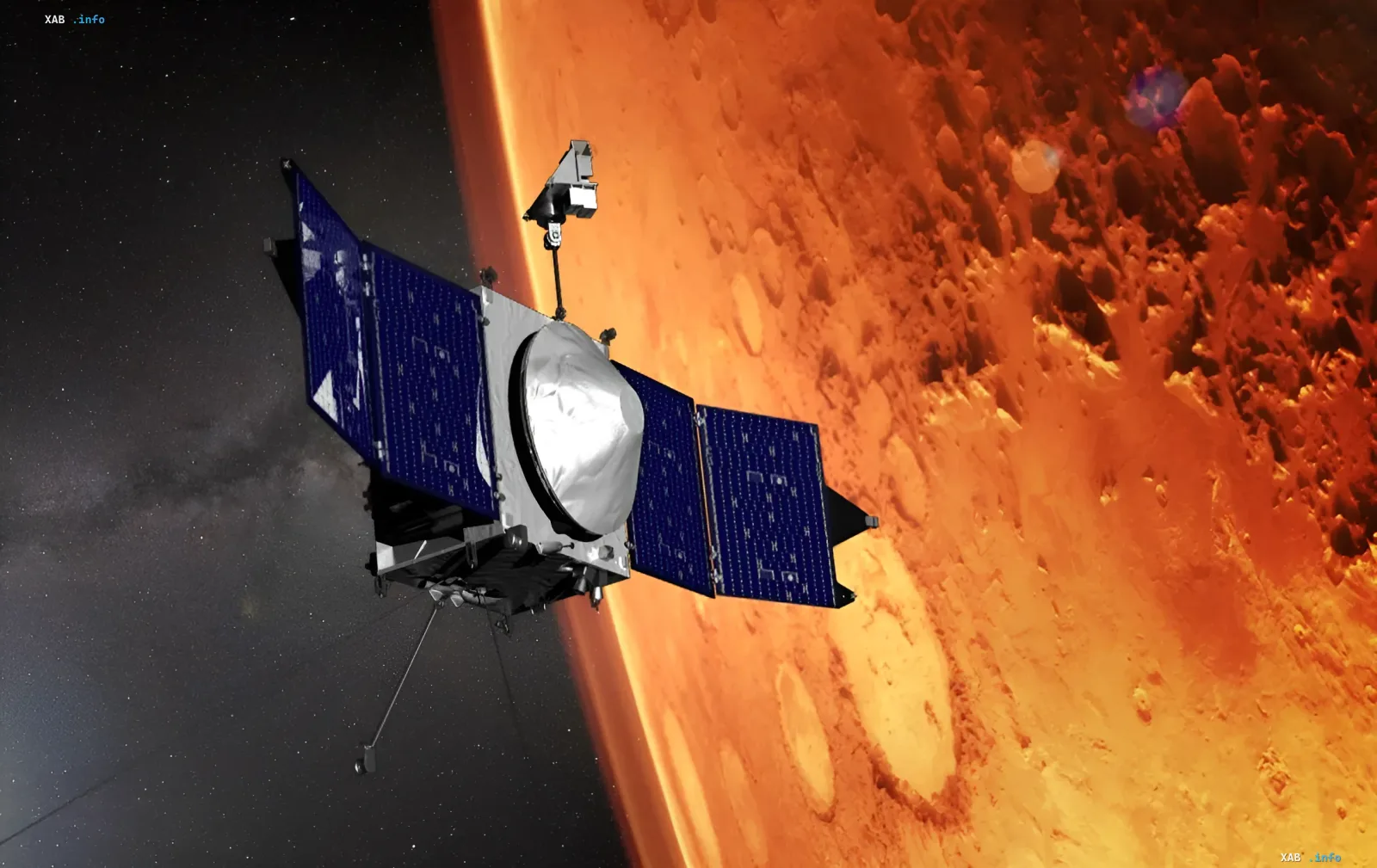
One of the longest-lived and most productive spacecraft in the history of exploring the Red Planet has ceased to exist. The NASA MAVEN spacecraft, which spent 11 years collecting unique data on the Martian atmosphere, has finally vanished. The probe disappeared after passing behind the planet, and engineers were unable to re-establish contact.
Technical catastrophe: how the station perished
The fate of the spacecraft was sealed within hours. Decrypted fragments of delayed telemetry and Doppler shift data obtained after the probe emerged from the planet's shadow told a grim story of technical failure. MAVEN began to rotate chaotically around its axis at a speed of about 2.7 revolutions per minute.
This proved fatal for the control system. The rotation speed was too high for stabilization, preventing the spacecraft from orienting its solar panels toward the Sun. Deprived of an energy source, MAVEN completely drained its batteries within just a few hours. Engineers at the Jet Propulsion Laboratory (JPL) admitted that restoring stable contact was impossible.
"NASA has ceased efforts to locate the MAVEN spacecraft and is initiating procedures to decommission the mission," officially announced project manager Mike Moreau of the Goddard Space Flight Center.
Scientists mourn the loss of a 'close friend'
For the scientific community, the closure of the mission was a heavy blow. Mike Moreau described the team's feelings in words comparable to the loss of a loved one. MAVEN was not just a collection of instruments but a key tool that changed our understanding of Mars' evolution.
Principal Investigator Shannon Curry of the University of Colorado Boulder emphasized the uniqueness of the probe's legacy. According to her, the spacecraft left behind the best understanding of atmospheric processes among all planets in the Solar System, including Earth.
The main discovery: how Mars lost its water
Over 11 years of operation, starting after its arrival in orbit in 2014, MAVEN answered a fundamental question: why did Mars turn into a cold desert, and where did its ancient rivers and lakes go?
Based on the collected data, scientists proved for the first time that the main cause of the atmosphere's disappearance is the solar wind. It literally "blows" gas molecules into open space.
"One of our most exciting discoveries was observing the process of atmospheric escape known as sputtering. This is a phenomenon where charged particles collide with the upper layers of the atmosphere and knock out the neutral atmosphere, similar to jumping into a pool with a cannonball," explained Shannon Curry.
Research confirmed that this mechanism dominated the planet's history for billions of years.
Who will now connect Earth with Mars?
In addition to fundamental science, MAVEN performed a critically important practical function. It served as a powerful relay, collecting signals from the Perseverance and Curiosity rovers and transmitting huge volumes of photos and data to Earth. This probe handled nearly 18% of all data from the Martian surface.
NASA Mars Exploration Program Director Tiffany Morgan reassured the public that communication with the rovers would not be interrupted. Four other satellites remain in orbit capable of backing up the mission, although three of them are older than the departed MAVEN.
However, to solve the communication problem in the long term, NASA is already engaging private companies. The agency plans to deploy a new commercial infrastructure called the Mars Telecommunications Network in the 2030s.
Physically, the spacecraft itself will continue to orbit Mars for a long time. MAVEN will remain in orbit for another 50 to 100 years, after which it will naturally burn up in the atmosphere of the Red Planet.


