
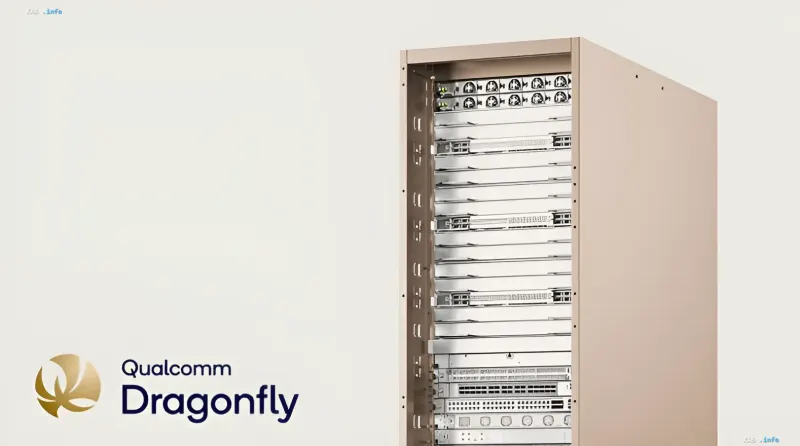
Challenging the Giants: Qualcomm Changes the Rules of the Game in the Server Segment
At its annual Investor Day event, American tech giant Qualcomm unveiled a strategy that could radically reshape the data center market landscape. The company announced the Dragonfly C1000 server platform — a solution based on Arm architecture designed to compete with dominant x86 systems and Nvidia's specialized Grace superchips.
This move marks Qualcomm's transition from the mobile ecosystem to direct participation in the race to build infrastructure for artificial intelligence. In a sector where AI training hardware is highly consolidated around the proprietary CUDA ecosystem, the emergence of an alternative becomes critical for the global market.
Dragonfly Architecture: The Power of Oryon Cores
The heart of the new platform is the Qualcomm Dragonfly C1000 processor. It is based on second-generation custom Oryon microarchitecture cores, which have previously proven their effectiveness in consumer mobile devices and Copilot+ class laptops. However, these technologies are now adapted for processing resource-intensive workloads: from training large language models (LLMs) to executing complex industrial simulations.
The key advantage of the solution is the optimization of performance per watt of power consumed. According to Arm consortium specifications, server processors based on such custom cores can demonstrate up to 30–40% higher energy efficiency when processing parallel data streams compared to standard CISC architectures. For data centers scaling to massive sizes, this parameter becomes a decisive factor.
New Interfaces and Accelerator Ecosystem
Qualcomm did not limit itself to just releasing a processor. The presented hardware ecosystem includes a number of innovative components designed to ensure seamless operation in heterogeneous environments:
- High Bandwidth Compute (HBC) Interface: A proprietary system bus with ultra-low latency. HBC is developed as an alternative to existing inter-chip connection interfaces, providing high end-to-end memory bandwidth within the server rack.
- Dragonfly AI300 Accelerator: A specialized AI accelerator positioned as an alternative to solutions based on Blackwell and Rubin architectures from key competitors. It is designed to perform specific computations in conjunction with the processor.
- Custom Silicon Division: A new service offering large hyperscalers and cloud infrastructure operators the development and customization of chips to their unique requirements.
Market Prospects and Supply Chain Diversification
Qualcomm's entry into the AI data center chip market comes against a backdrop of high production capacity utilization and a shortage of advanced accelerators. The integration of proven Oryon cores is viewed by analysts as an attempt to lower entry barriers through more flexible customization conditions.
The main factors capable of influencing the redistribution of market shares among the largest providers (including Microsoft Azure, AWS, and Google Cloud) will be the reduction of Total Cost of Ownership (TCO) thanks to the energy efficiency of Arm platforms, as well as the need to diversify semiconductor supply chains. In the context of global competition, having an alternative supplier of server equipment becomes a strategic necessity to ensure IT infrastructure stability.


