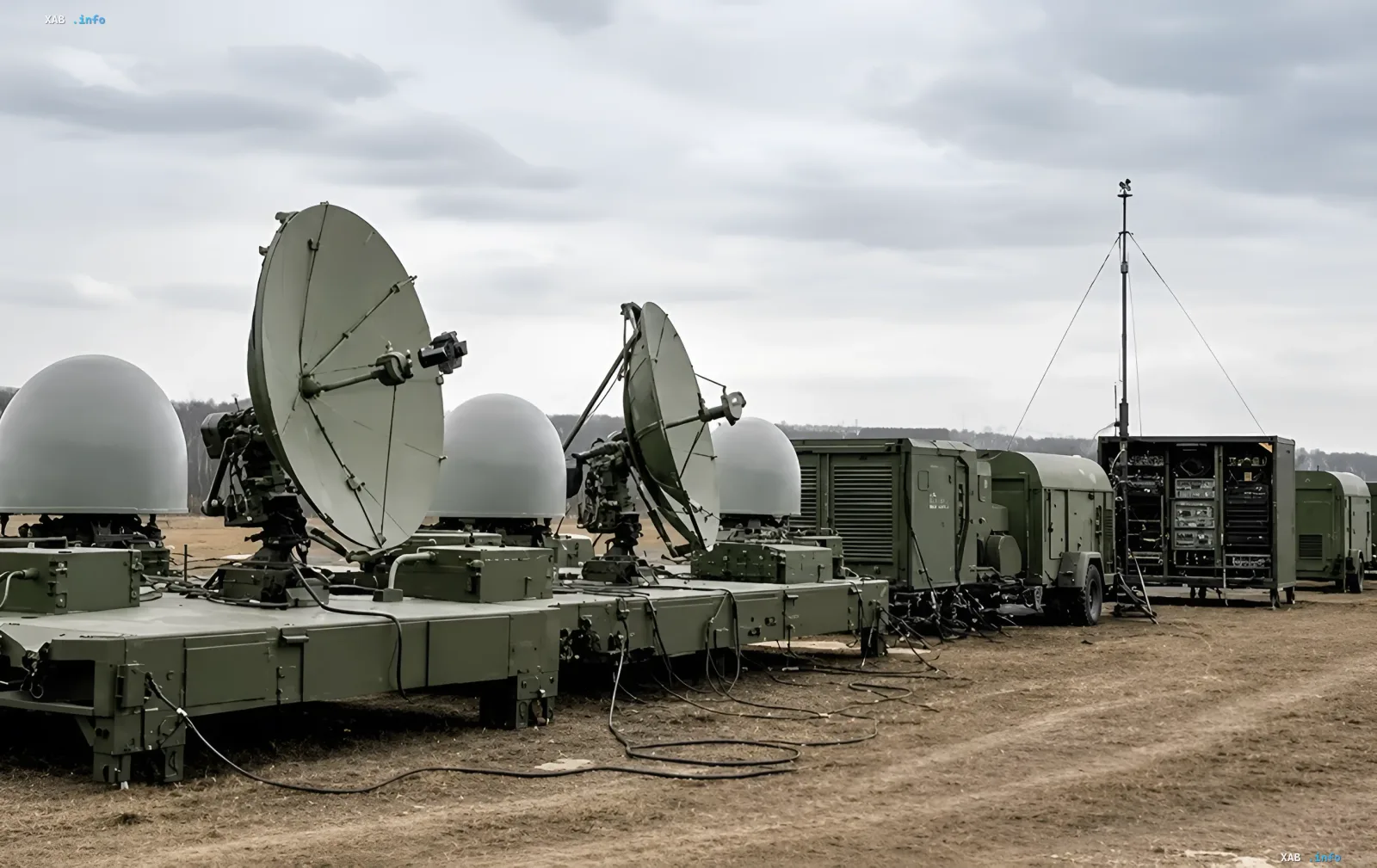
In occupied Crimea, in the Kerch area, the destruction of the Russian electronic warfare (EW) complex 'Volna Kupol Garant' has been confirmed. This event dealt another blow to the Russian army's attempts to suppress the operation of the Starlink satellite network, which remains a key element of communication for Ukraine's defense forces.
'Volna Kupol Garant': The Suppression Mechanism
The complex is a mobile system consisting of several trailers equipped with large satellite antennas. Its main task is to create powerful interference in the 14–14.5 GHz frequency range. It is in this range that a specific segment of the Starlink network operates. When a signal enters the 'Volna' zone of action, it leads to a complete interruption of communication with ground terminals.
One such complex is capable of providing 'protection' for a territory of approximately 20 square kilometers. The Russian manufacturer 'Russian Dome' keeps the technical specifications of its products secret; however, according to open sources, the cost of one complex is estimated at 150 million rubles.
Vulnerability of Powerful Weaponry
Despite its high cost and ability to jam signals, the complex has critical vulnerabilities that make it an easy target. Firstly, SpaceX possesses technologies for the operational detection of interference in communication channels. Secondly, the powerful radiation required to suppress the signal is detected by the reconnaissance satellites of partner countries. This allows Ukraine's defense forces to quickly locate the installation's coordinates and strike it using drones.
In the published images taken in June 2026, the aftermath of the strike is clearly visible: the sites of burnt installations and damaged equipment. Most of the trailers were moved after the attack, but the scale of the destruction is obvious.
Consequences for the Russian Army
The destruction of such complexes is just part of the bigger picture. After SpaceX blocked illegal Starlink terminals in February 2026, the Russian army faced a serious communications crisis. Assault operations on the front line were partially halted due to the inability to coordinate actions.
In an attempt to solve the problem, Russia began a mass search for alternatives, but its own satellite systems proved to be no less vulnerable. Thus, as early as April, Ukrainian drones, known as 'Madjar's Birds', destroyed the new compact satellite communication station Spirit-030 for the first time, which the Russian Federation began to mass-supply to the front as a replacement.


