
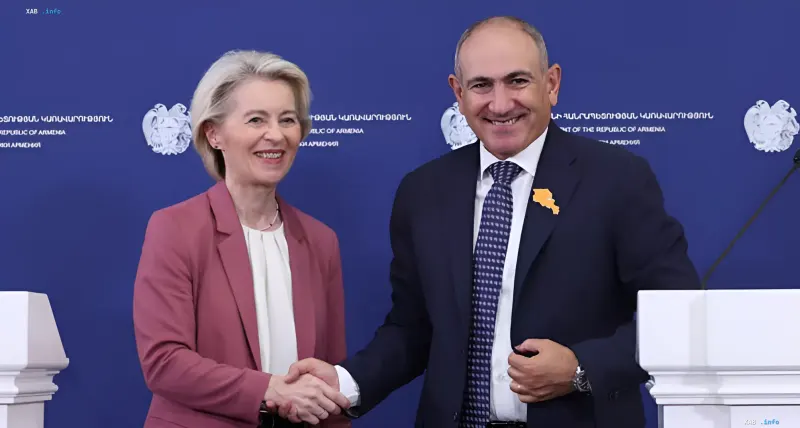
A major shift in the European Union's economic policy has been announced in Yerevan. On July 2, 2026, European Commission President Ursula von der Leyen, during a joint briefing with Armenian Prime Minister Nikol Pashinyan, announced the preparation of a regulatory package providing for a preferential trade regime for the republic. The key element of the initiative will be the exemption of customs duties for up to 80% of Armenian exports destined for the European market.
Economic strategy: from duties to investments
The regulation under development aims to systematically reduce tariff barriers for key sectors of the Armenian economy. According to the European Commission's draft proposals, liberalization will primarily affect the agro-industrial complex and manufacturers of finished goods. The specific parameters of the preferential regime are as follows:
- Agriculture: Complete elimination of import duties on fresh fruits, vegetables, live plants, and flowers.
- Food industry: Duty-free import of more than 90% of the assortment of alcoholic and non-alcoholic beverages of Armenian production.
- Financial support: Brussels plans to allocate targeted macro-financial assistance to Yerevan in the range of 52 to 80 million euros. These funds are intended for the modernization of logistics infrastructure and bringing the quality standards of Armenian goods in line with the norms of the EU Single Market.
To implement the program, a permanent monitoring group of European specialists will be sent to the republic. Their task is to assist in the certification of local enterprises according to the technical regulations of the European Union. It is important to note that the proposed measures are institutional in nature and will require mandatory approval by all EU member states, as well as ratification in the European Parliament.
Context: trade barriers and geopolitics
The intensification of economic dialogue between Yerevan and Brussels coincided with the escalation of the situation within the Eurasian Economic Union (EAEU). In May and June 2026, the Federal Service for Veterinary and Phytosanitary Surveillance of the Russian Federation (Rosselkhoznadzor) successively introduced temporary sanitary restrictions on a wide range of Armenian goods. Flowers, mineral water, vegetable products were banned, and fish imports were completely suspended on the grounds of non-compliance with safety standards.
Ursula von der Leyen characterized the actions of the Russian side as a form of economic pressure. According to her, opening the European market, which has 450 million consumers, will allow Armenia to reduce its vulnerability to external regulatory risks. Prime Minister Nikol Pashinyan, whose party "Civil Contract" retained its majority after the elections on June 7, 2026, stated that the issue of reorienting agricultural exports to the EU has been resolved at the political level.
Logistical challenges and legal grounds
Despite optimistic forecasts, experts point to objective difficulties. International analysts, including the DPA agency and economists from the Financial Times, note that Armenia's lack of direct access to the sea will require the organization of complex multimodal logistics for the transit of perishable cargo. In addition, the duty-free import of Armenian winemaking products may meet resistance from the agricultural lobbies of Southern European countries.
At the same time, from the point of view of international law, the EU initiative has a solid foundation. According to the General Agreement on Tariffs and Trade (GATT/WTO), the provision of unilateral trade preferences to developing economies is considered a legitimate tool for promoting sustainable economic development and diversifying the export structure.


