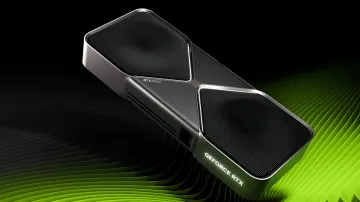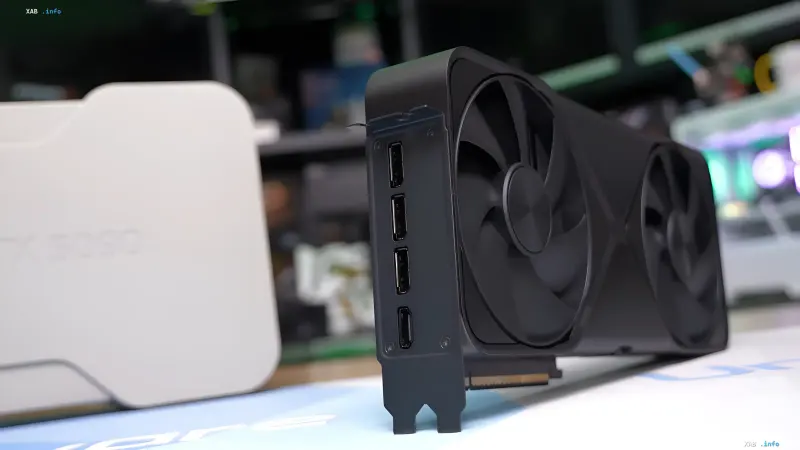
In August 2026, the PC gaming industry faced a new challenge that, seemingly, should have been resolved with the release of the Blackwell architecture. The GeForce RTX 5090, the absolute market flagship that outperforms competitors in all metrics, found itself at the limit of its capabilities when moving to resolutions above 4K. Independent tests conducted by the authoritative publication Hardware Unboxed demonstrate that even the most powerful graphics card in the world struggles to provide comfortable gaming at 6K resolution.
Performance drop in Cyberpunk 2077
The key evidence of difficulties with 6K gaming came from testing results in one of the most demanding games — Cyberpunk 2077. At 4K resolution with maximum Ray Tracing (RT Overdrive) enabled and DLSS upscaler set to Performance mode, the RTX 5090 delivers a confident 86 frames per second. However, when switching to a Samsung G80HS monitor with 6K resolution, performance drops exactly in half — to 42 fps. This is a critical figure that makes the game uncomfortable to play, despite the presence of upscaling technology.
The performance paradox: RTX 5090 vs RTX 5070 Ti
One of the most indicative test results involves comparing the performance of the flagship solution with a more affordable model. The authors of the study found that the RTX 5070 Ti at 4K resolution delivers almost the exact same number of frames that the flagship RTX 5090 can provide at 6K. This means that for gaming in 6K using DLSS in Performance mode, buying a top-tier card might be excessive if compared to its performance in 4K on the mid-range segment. The price difference between these cards is colossal, but under extreme resolution conditions, it is neutralized.
Testing in other games: Crimson Desert and Doom Dark Ages
The picture does not change in other modern projects either. Testing games like Crimson Desert, Mafia Old Country, and Doom Dark Ages showed a similar trend: the performance drop when moving to 6K is approximately twofold, and in some cases even higher. In absolute numbers, even with DLSS enabled (in various modes), the graphics card provides less than 60 fps in resource-intensive games, often dropping to the 40-45 fps range. Without using upscalers, the figures would be completely unplayable, highlighting the critical dependence on scaling technologies at such high resolutions.
Contradictory data
There is a nuance in the interpretation of these results. On the one hand, the authors of the Hardware Unboxed tests point out that 6K gaming at the current stage is a "monstrous load" that even top-tier hardware cannot handle. On the other hand, they note that the situation is not hopeless: switching the upscaler mode from DLSS Performance to DLSS Quality, lowering graphics settings, or disabling ray tracing always leads to a significant performance boost. This creates a dilemma: either sacrifice visual quality for smoothness in 6K, or stay in 4K, where the RTX 5090 reveals its full potential.
Conclusions for the market
Despite the fact that the number of gamers choosing monitors with 6K resolution remains extremely small, these tests are important for understanding the limits of current technologies. The RTX 5090 remains the best card on the market, but its capabilities are not limitless. For comfortable gaming in 6K without compromises, the emergence of the next generation of graphics cards or further refinement of DLSS algorithms capable of generating higher quality frames during heavy upscaling will likely be required.