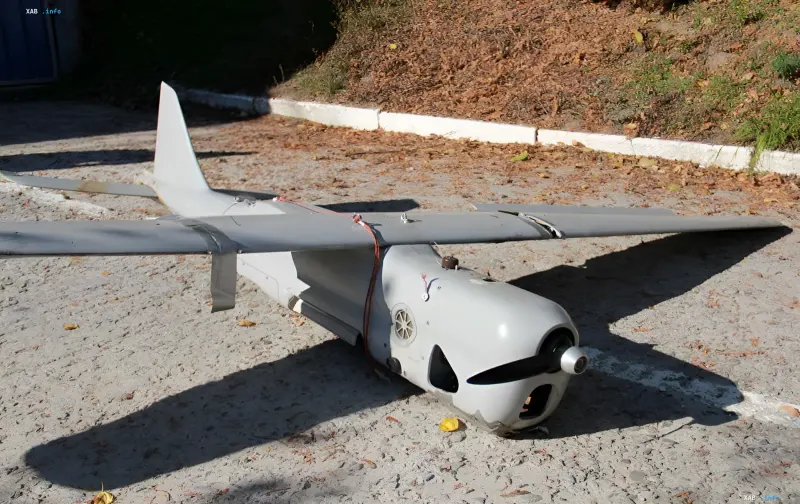
In recent years, reconnaissance drones used by the Russian Armed Forces have undergone a noticeable technological evolution. According to Kyrylo Liukov, head of the unmanned technologies department at the Serhiy Prytula Foundation, in an exclusive column for RBC-Ukraine, the key direction has been the introduction of mesh networks and relay chains, which provide more stable communications and expand the operational range of the devices. The photo shows a downed unmanned aerial vehicle lying on the ground after crashing.
Relay-Based Communication
The transition to distributed communication networks allows Russian operators to maintain control of the drone at great distances from the front line. Instead of direct radio communication with the operator, the signal is transmitted through a chain of relays, which reduces the likelihood of losing the channel and increases interference resistance. In practice, this means that a reconnaissance vehicle is able to operate deeper into enemy territory longer and more stably than was previously possible.
Optics and Safe Distance
Optical sensors are being upgraded in parallel. As the expert notes, this allows reconnaissance to be conducted from safer distances for the operator. The greatest threat, according to him, is posed by the Orlan-10 and Orlan-30 with gasoline engines, whose operational radius exceeds 150 kilometers. It is the combination of range, autonomy, and high-quality optics that makes these platforms a priority target for countermeasure systems.
Target Designators for Lancets
A separate group consists of devices operating in tandem with loitering munitions. Zala and Supercam drones, thanks to high-quality optics, act as target designators for Lancets, tracking the target and transmitting coordinates. Tactical scouts, in particular the 'Knyaz Veshchiy Oleg', are also used on a massive scale. The general trend, Liukov emphasizes, is obvious: hostile drones are becoming more complex targets and allowing the enemy to operate at greater depths.
A New Threat: Interceptors
The Defense Forces also have to take into account another factor — interceptor drones that hunt Ukrainian unmanned aerial vehicles, including reconnaissance ones. According to the expert, the more expensive the system, the more tangible its loss is for the unit. This changes the economics of drone use and forces a revision of flight tactics.
Broader Context
These changes are taking place against the background of other trends. Earlier, RBC-Ukraine reported that Russian jet-powered drones are able to cover significant distances and reach the western regions of Ukraine, and their range depends on technical characteristics, fuel reserves, and onboard equipment. Ukrainian air defense, according to the publication, is increasing the percentage of downed jet attack drones — the average destruction rate of Geran-4s is approaching 60%. In addition, Russia has significantly modified the Gerbera devices, which now, according to available data, are capable of covering up to 1,200 kilometers and carrying an increased payload.