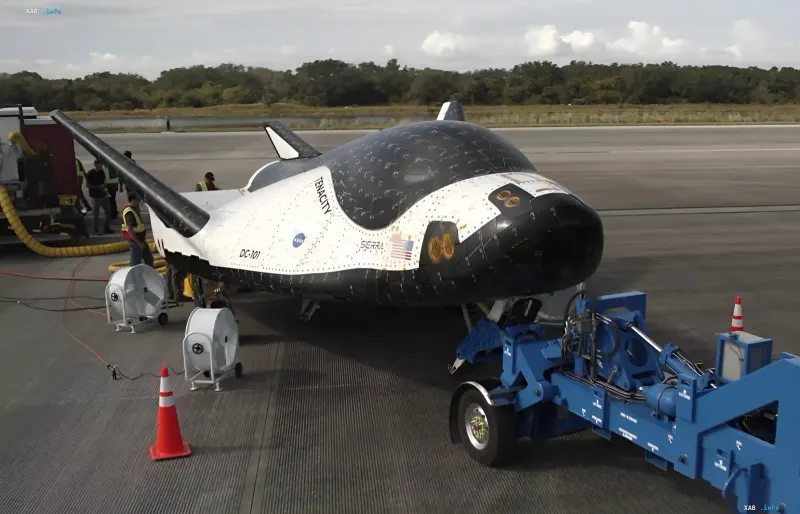
On November 9, 2026, the US Federal Aviation Administration (FAA) issued a license to Sierra Space for the return of the Dream Chaser spaceplane from space and its landing on the runway at the Vandenberg Space Force Base in California. The following day, November 10, Sierra Space officially confirmed receiving the permit. The license is valid for five years and authorizes up to four orbital returns annually, provided that the vehicle's design and mission profile remain unchanged. This is a crucial regulatory step without which no crewed or uncrewed spacecraft can legally land on US soil.
Landing Instead of Splashdown: What the License Changes
Unlike traditional capsule ships that splash down in the ocean, the Dream Chaser is designed as a glider: after exiting the atmosphere, the vehicle glides like an airplane and lands on a runway. According to Sierra Space, during reentry, cargo experiences forces of less than 1.5 g, and any runway suitable for a Boeing 737 is sufficient for landing. This is critical for sensitive scientific experiments and medical equipment that could be damaged by a rough splashdown. The first spaceplane, named Tenacity, is designed to carry about 5,500 kg of cargo to orbit and return up to 1,850 kg. Before launch, its wings fold to fit the rocket's payload fairing.
Vandenberg Instead of Kennedy: How the Site Changed
The landing site has undergone significant changes compared to the initial plan. In 2024, when the FAA was conducting an environmental assessment of the project, Sierra Space proposed using the former Space Shuttle landing facility at the Kennedy Space Center in Florida, with Vandenberg considered only as a backup. The issued license now specifies the California base. The change in logistics stems from the fact that the launch is planned from a Florida spaceport on United Launch Alliance's Vulcan Centaur rocket, while the landing occurs on the West Coast, leveraging Vandenberg's existing infrastructure.
From NASA Contract to Independent Mission
Initially, the Dream Chaser was developed under a 2016 NASA contract to resupply the International Space Station. However, after repeated delays, including issues with the propulsion system, the parties revised the agreement in September 2025. The first flight is now set to be an independent orbital mission: the vehicle will not dock with the ISS. If the demonstration proves successful, NASA may later order individual missions to deliver cargo to the space station. Thus, the FAA license covers the regulatory aspect of the landing itself but does not replace a launch authorization, which will require separate approval.
First Flight: Timeline and Payload
In September 2026, Sierra Space entered into agreements with customers from the national security and commercial sectors, who will also send payloads on the inaugural flight alongside NASA cargo. The company has not disclosed the organizations' names or cargo composition: the mission manifest is still being formed. Sierra Space had previously targeted a launch for late 2026, but there is no current confirmation that this schedule remains intact. Timelines depend, among other things, on the availability of the Vulcan Centaur rocket, which is in the final stages of testing. The date of the first flight has not been announced as of the time of publication.
Significance for the Industry
Issuing the landing license for the Dream Chaser on airfield infrastructure sets a precedent for a whole class of orbital gliders capable of returning cargo in a “door-to-door” mode without the need for water-based rescue operations. For NASA, this potentially lowers the cost of delivering sensitive experiments to orbit, and for commercial customers, it expands the range of tasks performed in microgravity conditions. The next expected step is the publication of the FAA permit for the launch itself from the Florida spaceport.