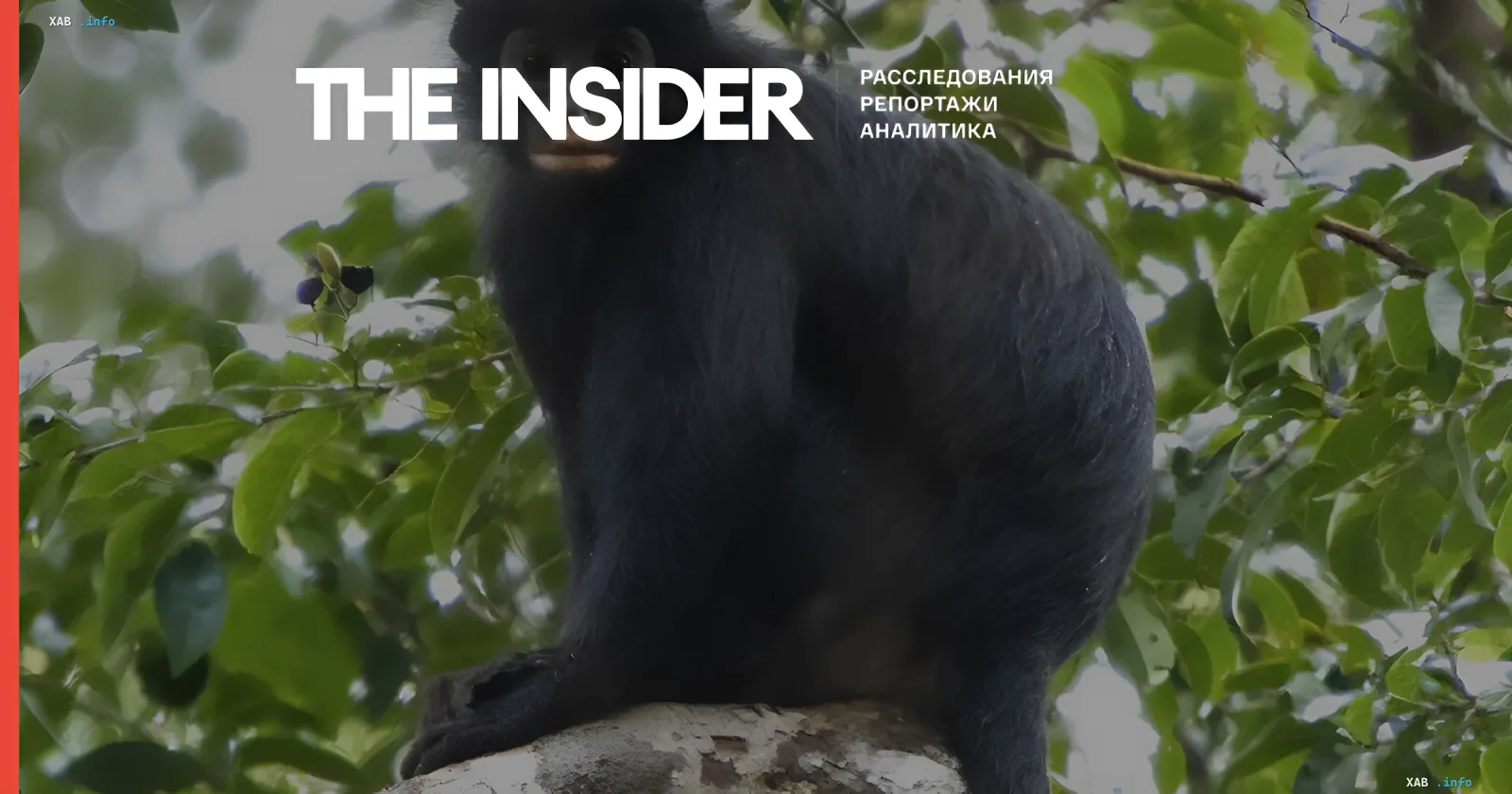
A rare event has occurred in the world of science: a new species of African monkey has been officially described in the Democratic Republic of the Congo. Scientists have given it the Latin name Colobus congoensis, while locals call it the "likweli." This discovery, published in the prestigious journal PLOS One, marks only the fifth time a new species of African monkey has been found in the last 75 years.
A secretive inhabitant of a narrow forest strip
The likweli is a truly rare and elusive creature. It inhabits Lomami National Park and its surroundings, living in a narrow strip of forest squeezed between the Lomami and Luapula rivers in the center of the country. Researchers conducted extensive work: from 2018 to 2022, they recorded the presence of the monkey only 114 times across an area of about 1,700 km².
Surprisingly, even people living near the forest know little about this species. During surveys in 52 villages, descriptions of the monkey could only be provided by residents of eight settlements. The first photos of the unknown animal were taken as early as 2008, but it was not until 2018 that a patrol led by the Congolese Jean-Pierre Kapale obtained footage that unequivocally confirmed: science had encountered a new species.
Appearance and voice: unique features
Visually, the likweli resembles no one else. With almost completely black fur, the monkey has a striking orange-cream patch around its mouth, creating the effect of a "smudged" face. Due to the dark skin around the eyes and the lighter skin around the lips, the muzzle looks like a mask. A white patch is also clearly visible under the tail. In size, the likweli is noticeably smaller than its relatives.
Scientists proved the uniqueness of the species by comparing skull structure, teeth, DNA, and even voice. Analysis showed that the likweli's closest relative is the black colobus Colobus satanas, which lives 1,200 km away in western Central Africa. The likweli's roar is similar to its relative's — it consists of frequent, rapid sounds, but between series, the monkey emits a characteristic snorting sound not found in other species.
Divergence in the Pliocene epoch
According to researchers, the ancestors of the likweli and the black colobus diverged approximately 4–5 million years ago, during the Pliocene epoch. This is the deepest divergence between two related species within the entire genus of colobus monkeys. Scientists suggest that the cause of isolation was not glacial cycles, as often happened with other monkeys, but changes in river courses and topography in the Congo Basin. The wide Lomami River apparently still serves as a barrier, preventing the monkeys from spreading westward.
On the brink of extinction
The authors of the study propose assigning the likweli the status of an endangered species. The monkey has a tiny range, is rarely encountered, and lives in small groups — averaging six individuals. The main threats to the survival of the species are deforestation, rapid population growth in the DRC, and hunting.
Most of the likweli's habitat falls within the protected area of Lomami Park. According to scientists, protecting this park is the key condition for ensuring that the new species does not disappear without a trace.


