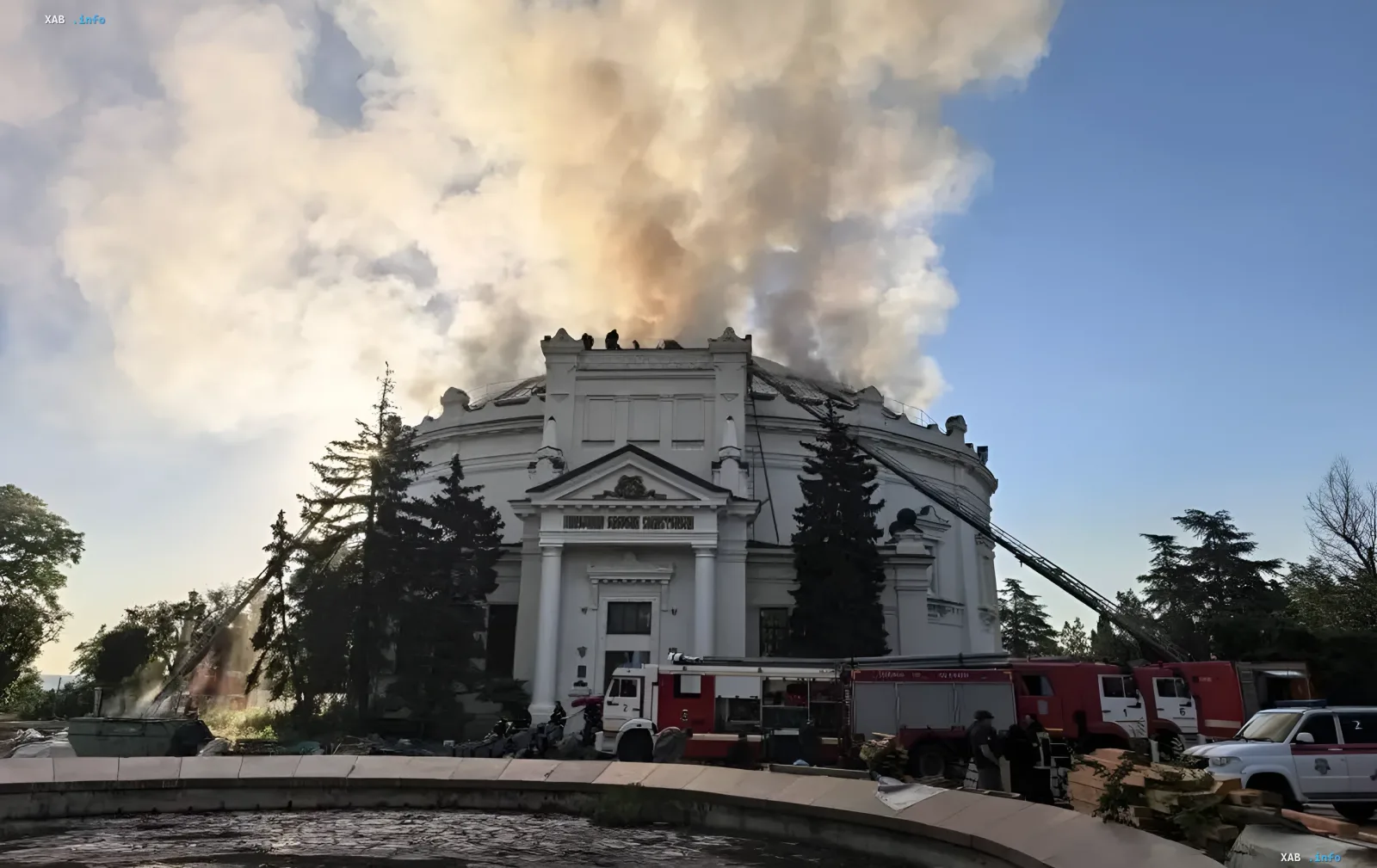
On the night of September 19, an event occurred in occupied Sevastopol that Russian propaganda quickly turned into a major information pretext. The building of the 'Defense of Sevastopol 1854–1855' panorama was engulfed in flames. The fire and thick smoke rising above the historic building became the basis for loud statements from Russian authorities and Kremlin spokespeople.
The 'Occupiers' Version: A Blow to History
So-called Sevastopol Governor Mikhail Razvozhayev was the first to react to the incident. In his statement, he accused Ukraine of a targeted strike on the building using a drone. According to Razvozhayev, the 'great masterpiece by Franz Roubaev was practically destroyed'.
This line was supported by Russian President's Press Secretary Dmitry Peskov. He stated that the 'Kyiv regime has begun striking at history', but added that 'history cannot be defeated'. Peskov promised that the object, which has 'important symbolic and historical significance', would be restored and become 'better than before'.
Reality: Air Defense Operations and Fakes About the Painting
However, the factual picture of events looks different. The Telegram channel 'Crimean Wind' notes that the fire in the panorama building was the result of the Russian air defense system (PVO). The authors of the channel point out that Russian military facilities are located near the historic object, which makes the version of an air defense missile hitting the building more likely than a targeted drone strike.
During the night and morning, air raid alerts were announced in the city four times. Two powerful explosions were heard in Sevastopol itself. There is currently no information about casualties.
What Actually Burned?
The Center for Strategic Communications and Information Security (SPRAVDI) refuted Russian propaganda claims about the 'destruction of an outstanding canvas'. According to the Center, Russian resources are manipulating facts twice.
First, the original 19th-century work could not have been damaged. The canvas, restored after the 1942 fire, is stored in another building. Second, according to the museum itself, the current exhibition, which is a copy, has also not suffered any damage.
Experts explain that after World War II, Russian artists simply painted a new canvas, which they called 'more beautiful than before'. 'It actually has no artistic value. The value is purely historical: it reminds of the attempts of the imperial family to distort the events surrounding the defeat of the Russian Empire in the Crimean War', say specialists.
Historical Context and Current Situation
The panorama 'Defense of Sevastopol 1854–1855' is dedicated to the events of the Crimean War, which ended with the defeat of the Russian Empire by a coalition of the Ottoman Empire, Great Britain, France, and the Kingdom of Sardinia. As a result of the Paris Peace Treaty, the Black Sea was declared neutral, and Russia lost the right to have a military fleet there.
While the Kremlin tries to use the fire for propaganda purposes, reality on the peninsula is changing. Ukrainian intelligence continues to carry out attacks on Russian army military convoys in temporarily occupied Crimea. Railway warehouses used for transporting ammunition, military equipment, and fuel are becoming targets of strikes.
In addition, a shortage of certain goods is being recorded in stores on the occupied peninsula. Sugar, cereals, flour, and pasta are disappearing from the shelves. In this regard, retail chains have introduced restrictions on the sale of products to one person.


