
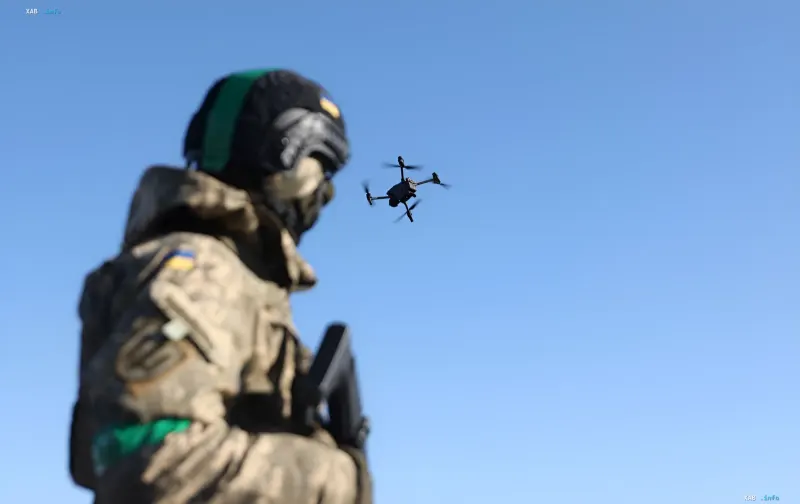
Ukrainian military forces have established effective fire control over the temporarily occupied Horlivka in the Donetsk region. The city, which has been a key rear hub for Russian forces since 2014, has now become a high-risk zone for the occupiers. Any equipment attempting to enter the city is subjected to regular attacks.
"Everything that enters burns there"
RBC-Ukraine reports this, citing the press center of the 28th Separate Mechanized Brigade "Knights of the Winter Campaign". Operators of the "Vspyshka" Unmanned Aerial Systems Battalion (UASB) have significantly expanded the geography of their strikes, hitting the enemy's logistics system in their deep rear.
According to the military, the situation has changed radically. If Russian units could previously move relatively calmly in the Horlivka area, their transport flows are now under constant aim.
"Trucks, cars, ATVs — everything that enters the temporarily occupied Horlivka burns there," the brigade's statement notes.
Horlivka is located approximately 35–40 kilometers from the front line of the Armed Forces of Ukraine. Despite this, Ukrainian drones successfully reach their targets, turning the city into a trap for Russian equipment.
Strategic importance of the logistics hub
Horlivka is one of the largest cities in the Donetsk region, captured by pro-Russian militants in the spring of 2014. Since then, and especially after the start of the full-scale invasion in 2022, it has become a critically important logistics hub. Through it, Russian occupiers transfer ammunition, equipment, and personnel to various sections of the front.
Nazariy Barchuk, an analyst at the Ukrainian Center for Security and Cooperation, commenting for RBC-Ukraine, confirmed the strategic importance of these events. According to him, establishing fire control over Horlivka fits into a broader campaign by the Defense Forces aimed at striking the enemy's deep rear.
According to the analyst, this campaign began back in May of this year. Its results are already visible: Ukrainian forces have established control over key transport arteries, including highways between Rostov and Crimea, as well as routes in the Luhansk region.
The "Logistics Lockdown" effect
Barchuk emphasizes that Horlivka plays a decisive role in supplying the enemy in the Kramatorsk direction. It is here that the Russians base their equipment and personnel. Establishing control over this hub directly limits the occupiers' ability to deliver resources to the front line, in particular to the fortified area of Kramatorsk.
"The enemy's logistics to Kramatorsk is severely hampered, which can cause delays in offensive actions and restrict the enemy in every way," the expert summarizes.
Furthermore, other key routes are also under attack, such as the highways from Sviatohirsk to Bakhmut and from Donetsk to Berestok. Although control over them may not be as total as over Horlivka, Ukrainian drones also strike them regularly.
Scaling attacks on the rear
In recent months, the Ukrainian army has intensified attacks on military facilities, warehouses, and logistics in the enemy's deep rear. Strike drones play a significant role in this, capable of hitting targets tens of kilometers from the line of contact.
To systematize these efforts, the Ministry of Defense of Ukraine, together with the General Staff, launched the "Logistics Lockdown" program. Its goal is to scale strikes on the Russian rear at operational depth.
Currently, the Defense Forces maintain an advantage in the use of strike drones. According to data, the ratio on the front is 1.3 to 1 in favor of the Armed Forces of Ukraine. This allows not only to destroy equipment but also to effectively control enemy communications, as happened with Horlivka.
Previously, Ukrainian defenders have already demonstrated the ability to take control of enemy positions using drones and ground robotic complexes, minimizing infantry involvement. In April, there were reports of establishing control over logistics around Donetsk, where all military targets of the occupiers are now being destroyed. Horlivka became the next important step in this strategy.


