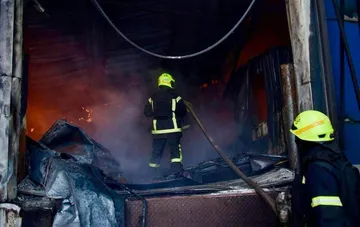
Amid ongoing Russian strikes on infrastructure in Ukraine, public anxiety is growing over possible food shortages. Ukrainian President's Advisor on the development of defense technology sectors, Sergey "Flash" Beskrestnov, issued a detailed statement in his Telegram channel, urging citizens not to fall for rumors or panic. According to him, producers and retailers are already reconfiguring their supply channels, adapting logistics to the changed conditions, and, if necessary, food gaps can be filled through imports from Europe.
Rebuilding Supply Chains as a Response to the Strikes
Beskrestnov emphasized that potential problems with certain supply chains are not due to an inevitable shortage, but to the need to rebuild them. "Friends, we will not 'starve to death.' Do not fall for rumors, disinformation, or panic," the President's advisor wrote. In his assessment, retail and suppliers are already changing delivery routes, relocating stockpiles, and reorganizing product storage systems, which helps minimize the consequences of strikes on distribution centers.
European Imports as a Safety Net
Separately, Beskrestnov outlined a reserve scenario for ensuring food security. "If needed, Europe will 'gladly' fill any food niche through exports," he stated. Thus, even in the most unfavorable scenario, where domestic supply chains are significantly disrupted, Ukraine has a mechanism for quickly making up the deficit through imports from EU countries, which, in the advisor's view, rules out the risk of systemic hunger.
The Target of the Attacks Is Big Business, Not "Food"
Commenting on the nature of the Russian strikes, Beskrestnov stressed their economic rather than humanitarian character. "Our enemy is not attacking 'food.' It is attacking big business that pays taxes and creates jobs," he stated. In his logic, strikes on distribution centers and warehouse complexes are aimed at causing economic damage and destabilizing the business environment, not at depriving the population of food as such. At the same time, he urged Ukrainians to rely on verified sources of information and not spread unverified data about an alleged inevitable food crisis.
Contradictory Data
The text of the statement and the surrounding context in RBC-Ukraine contains significant factual tension. On the one hand, the outlet previously reported that Russia had destroyed up to 90% of food warehouses in Ukraine — a figure that in itself indicates the scale of the destruction of logistics infrastructure. On the other hand, the President's advisor presents the situation as manageable: retail is adapting, the range of products may temporarily shrink, but there will be no systemic shortage. Neither side provides independent data on the actual level of destroyed warehouse capacity, and the 90% estimate has not been confirmed by international observers or official reports from the SBU. Meanwhile, retail chains are only noting "temporary delays in supply and a certain reduction in the range of products," which does not fully align with the scale of the reported destruction. Thus, there remains a gap between the damage assessment and the actual situation on store shelves, which is not clarified either in Beskrestnov's statement or in RBC-Ukraine's materials.
Context of the Ongoing Strikes
Beskrestnov's statement came against the backdrop of continuing drone attacks on Ukrainian infrastructure. Previously, in his statements, he explained why strikes from the northern direction, including the use of relays in Belarus, would continue, though not in a mode of constant online monitoring. This indicates that the threat to logistics and energy persists in the medium term, and the rebuilding of supply chains remains not a one-off measure but a prolonged process requiring resilience from both businesses and consumers.