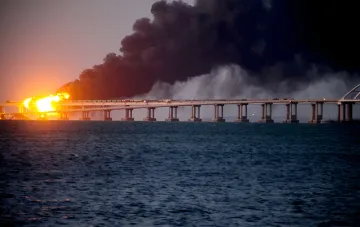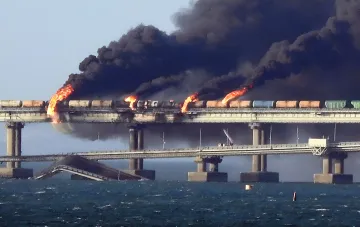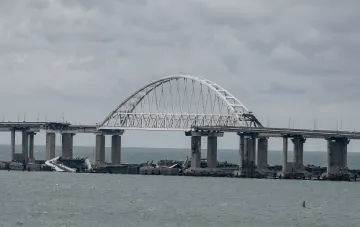
The attack on the Crimean Bridge, carried out on November 16–17, became not just another strike on Russia's strategic infrastructure, but also a demonstration of a new technological approach by the Ukrainian naval forces and the Armed Forces of Ukraine. According to the Financial Times, citing multiple defense sector sources, Ukrainian units deliberately abandoned the use of Starshield — the military version of Elon Musk's Starlink satellite network — and instead deployed their own relay system, already dubbed "flying modems" in the media space. According to experts, this very technology ensured a stable communication link with munitions over distances of hundreds of kilometers right up to the moment of impact on the bridge's support arch.
The Problem That Had to Be Solved: Starlink Speed Limits
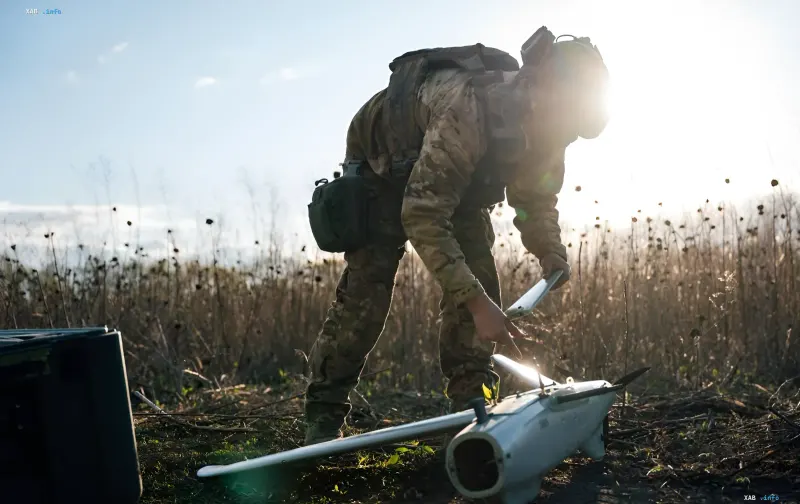
The key obstacle to using the satellite channel in this operation was the speed of the Starshield connection, which, according to available data, was capped at 161 km/h. For successful guidance of a high-speed munition against a moving or large-scale target at a long distance, this figure proved insufficient. Ukrainian developers and operators decided to switch to an alternative architecture: a network of unmanned aerial vehicles carrying communication stations that act as relays. These "flying modems" form a mesh network that maintains a constant and stable communication channel between the operator and the missile or drone throughout the entire flight — from launch to the final second before striking the target.
From Autonomous Guidance to Guided Strike
Previously, Ukrainian medium-range drones and missiles were programmed exclusively using pre-set coordinates and operated autonomously. This approach made the devices vulnerable to electronic warfare and anti-aircraft missile systems: without the ability to correct the trajectory in real time, the probability of interception increased. The new relay system radically changes this logic. The operator gains the ability to make corrections in flight, target the most vulnerable structural elements of the target, and, crucially, evade the air defense kill zone. According to specialists, this significantly reduces the losses of Ukrainian strike assets and increases strike accuracy.
"Flamingo" at the Arch: Video from Fire Point
A clear confirmation of the new link's operability was a short video published by Fire Point. The footage captures the moment when the FP-5 "Flamingo" missile with a warhead weighing up to 1,200 kg flies directly toward the support arch of the Crimean Bridge. According to experts, the video transmission quality demonstrates the stability of the communication channel provided precisely by the relay network rather than the satellite channel. President Volodymyr Zelenskyy confirmed the strike on the Crimean Bridge in his address and listed the types of weapons used in the operation: FP-5 "Flamingo", R-360 "Neptune", "Palyanytsia", "Ruta", and FP-1.
Chronology of Strikes and Recorded Damage
The Crimean Bridge was subjected to two attacks within two days. On November 16, following the first strike, satellite imagery captured damage to the roadbed in several places as well as deformation of the support arch. On the night of November 17, explosions rang out again in the Kerch Strait area; OSINT publics reported the collapse of a section of the road span and arch elements into the water. Thus, within two days, the bridge sustained damage at both the road and rail levels, which, according to RBC-Ukraine, led to the factual blockade of the logistics corridor through the Azov Sea.
Russian Counterpart and Countermeasures
According to the Center for Defense Strategies (Defense Reforms Center), Russia is also attempting to deploy a similar mesh-modem system controlled via ground stations in Russia and Belarus, predominantly using Chinese equipment. However, as noted in the Ukrainian defense department, effective ways to jam such networks have already been found. This means that technological superiority in the relay communication segment is becoming a two-way field of rivalry, where each party strives not only to build its own infrastructure but also to break that of the adversary.
Strategic Context: The Path to Mass Implementation
Commenting on the Kerch Strait operation, experts emphasize that it paves the way for a future in which the majority of Ukrainian medium-range drones will use relay network technology to strike enemy targets. The transition from autonomous guidance to a controlled communication channel via "flying modems" turns every strike device from a single-use "coordinate" missile into a flexible tool capable of adapting to the tactical environment in real time. For Ukraine's defense industry, this means a new round of investment in the UAV-relay segment and accompanying electronics, while for the adversary, it necessitates a revision of the counteraction doctrine built predominantly on suppressing satellite and ground communication channels.