
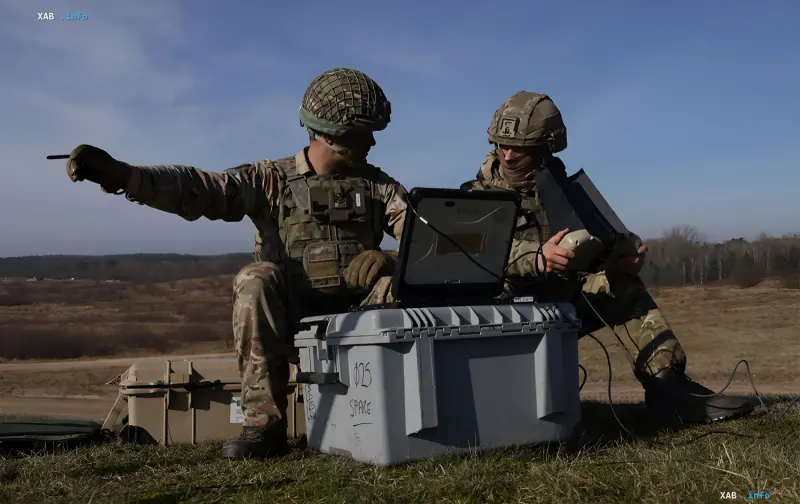
Large-scale military exercises codenamed Flytrap have concluded in Lithuania, involving military personnel from the United States and the United Kingdom. These maneuvers represent a key step in refining NATO tactics for countering unmanned systems and strengthening the defense of the Alliance's eastern flank. The range was used to test the latest technologies for protection against aerial threats under the conditions of modern maneuver warfare.
Testing 50 latest developments
The Flytrap exercises, which began last year, were initially conceived as a deterrence initiative on the eastern flank. While previous training took place in Germany and Poland, the Lithuanian phase became the most extensive and complex. Under the leadership of the US Army's V Corps and the US Army Europe and Africa command, units practiced countering drone attacks at the squadron level.
During the maneuvers, the military tested more than 50 different developments. The list of test equipment included:
- Interceptor drones;
- Specialized target detection systems;
- Various sensors;
- Unmanned ground platforms.
Particular attention was paid to the integration of British and American data exchange systems. The US Army's Chief Technology Officer, Dr. Alexander Miller, noted that the UK is one of the key partners in developing such capabilities, actively implementing innovations to protect personnel.
Protection on the move, not in a trench
The main philosophy of the Flytrap project was the integration of counter-drone measures directly into maneuver combat operations. Dr. Miller emphasized that the task was not simply to protect static objects, but to enable soldiers to continue fighting, moving, and maintaining communication under the protection of anti-drone systems.
"How do we bring all this together so that soldiers can still fight, move, and communicate with a defense system that works around them to protect them? That is the origin of Flytrap," explained the American official.
Searching for cheap solutions
The US Army is also working on reducing the cost of countering drones. Instead of using expensive missiles or specialized interceptor drones, the military is testing alternative solutions. In particular, munitions with non-contact fuses were tested, which can be fired from standard machine guns. Such rounds explode near the target, creating a cloud of shrapnel capable of damaging drones.
Miller added that effective counter-drone operations do not always require high technology. Basic elements play an important role: maneuvering, camouflage, and the use of protective nets. The military provides operational feedback to manufacturers, helping engineers refine systems in real-time.
Future of exercises and context
The next phase of the Flytrap exercises is planned to be conducted at the brigade level. Preparation for it is expected to take longer, but it will be the most technologically complex in the project's history. Experts note that against the backdrop of the growing role of drones in modern conflicts, such maneuvers strengthen cooperation between the US and European allies.
The exercises in Lithuania are taking place against the backdrop of increased NATO activity in the region. Recently, the alliance conducted training on the Swedish island of Gotland in the Baltic Sea, where it practiced scenarios of a possible attack. Furthermore, the threat from Belarus has been discussed more actively in recent times, affecting not only Ukraine but also NATO countries.


