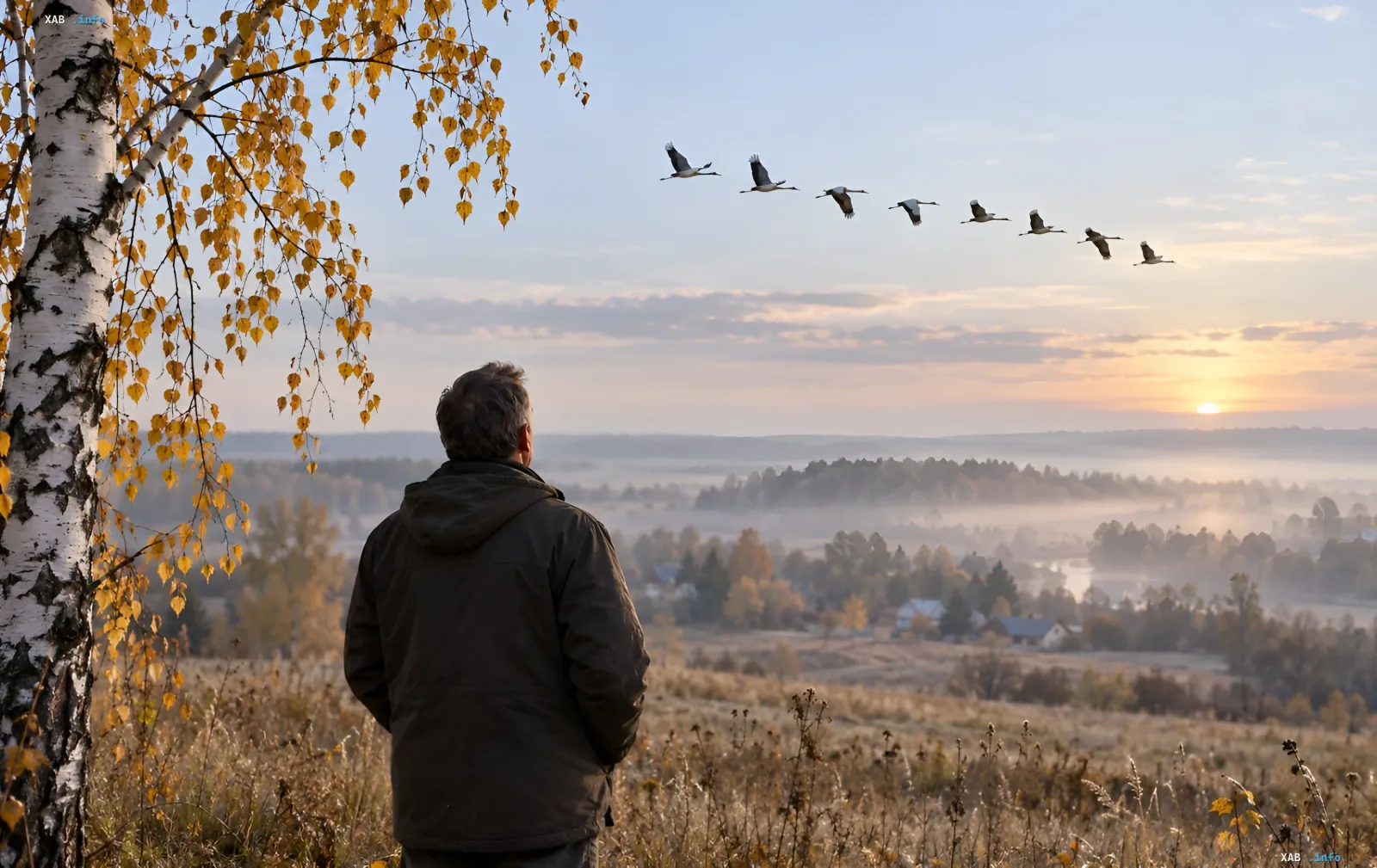
October in the traditional folk calendar has always held a special place, acting as a natural boundary between the warm season and approaching cold weather. In the absence of modern meteorological stations and satellite weather forecasts, our ancestors had to rely entirely on their own powers of observation. They closely recorded the slightest changes in flora and fauna, linking bird behavior, vegetation status, and wind direction with upcoming climatic shifts.
Bird and Animal Behavior as the Main Indicator of Autumn
One of the most reliable and famous benchmarks for determining the timing of frosts has long been the departure of migratory birds, particularly cranes. According to ethnographic sources, such as the 'Mamayeva Sloboda' folk calendar, birds heading to warmer regions in early October—traditionally celebrated on Yarina's Day—signaled that the first hard frosts could be expected in about two weeks. An early departure of cranes was perceived as a harbinger of an early winter, while their delay promised a long preservation of relatively comfortable weather.
Plant World and Natural Barometers
Trees and their foliage played an equally important role in folk meteorology, serving as a kind of living calendar. If the leaves on birches, cherries, and oaks stayed on the branches for a long time and fell off reluctantly, villagers prepared for a prolonged autumn and a later arrival of cold weather. Conversely, the rapid and unanimous stripping of trees was regarded as a sure sign of the impending winter weather. Additionally, the character of the season was judged by cobwebs: their abundance in October indicated clear, warm days and a delay in frosts.
Wind Directions and Atmospheric Phenomena
Wind direction was also reflected in folk omens: northern and north-eastern winds were traditionally associated with a sharp cold snap, while southern flows promised the preservation of warmth. At the same time, modern science and ethnographers, including researcher Serhiy Makarchuk, emphasize that all these observations were probabilistic in nature. Folk omens helped our ancestors navigate household chores, but today complex meteorological data are necessary to accurately determine frosts.