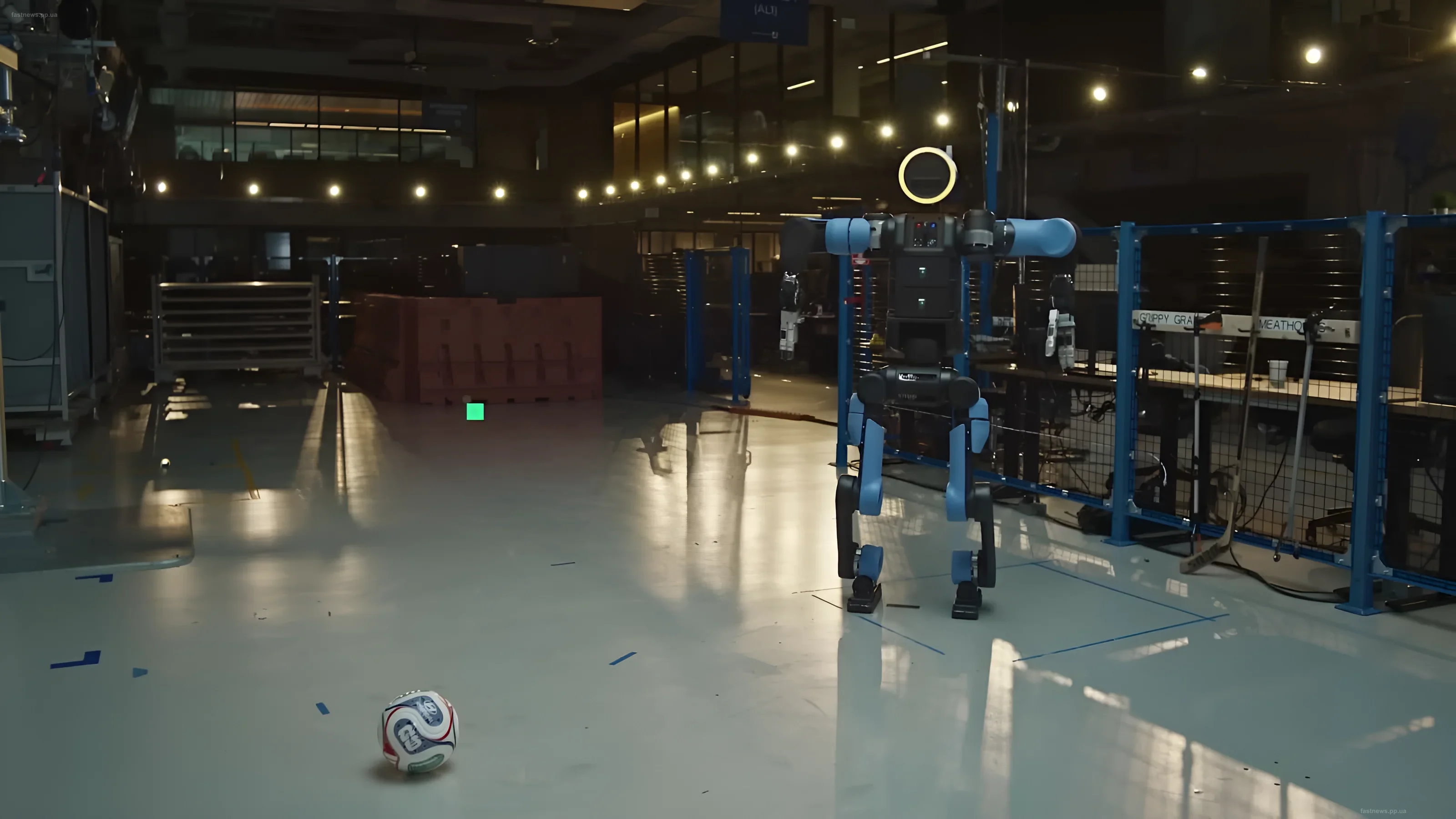
The humanoid robot Atlas from Boston Dynamics has moved beyond performing parkour stunts to mastering the nuances of a sport. The company has released a video showing how the machine analyzes World Cup matches and instantly transfers the observed techniques to a training ground. This experiment, timed for the 2026 World Cup, is part of Hyundai's "Football School" project.
The essence of the training lies in observation and imitation. First, the robot studies video recordings, analyzing the biomechanics of players: weight transfer, body position, and reaction to the ball. Then Atlas moves to practice, repeating movements with amazing precision. The video shows him smoothly extending his leg to control the ball and performing complex coordination exercises. With each repetition, the movements become less mechanical and more natural.
Of particular interest are the scenes where the robot copies the emotional reactions of athletes. After a successful kick, Atlas raises his hands in a gesture of triumph and then demonstrates an imitation of an injury by dropping to one knee. These actions are performed immediately after watching the corresponding episodes, indicating a high level of context recognition.
The basis of the progress is reinforcement learning. The parent company notes that millions of hours of simulations were conducted on powerful graphics processors to hone skills. In the virtual environment, parameters were changed: object weight, floor traction, and resistance force. This allowed them to avoid the effect where a skill practiced in simulation fails in the real world due to sensor inaccuracies.
Atlas does not rely solely on cameras. Proprioception plays a key role—the ability to "feel" the position of its own body, load, and balance. This allows the robot to correct movements in real-time while working with unstable objects. Previously, the company has demonstrated how Atlas carries heavy loads while maintaining balance, and now the focus has shifted to adaptive behavior and reaction to visual stimuli.
Although the specific role of robots at the 2026 World Cup is not yet revealed, Hyundai has already hinted at the participation of Atlas and his four-legged colleague Spot in the events. Football exercises are not just entertainment but a test of skills necessary for work in warehouses, construction sites, and production facilities in the future.


