
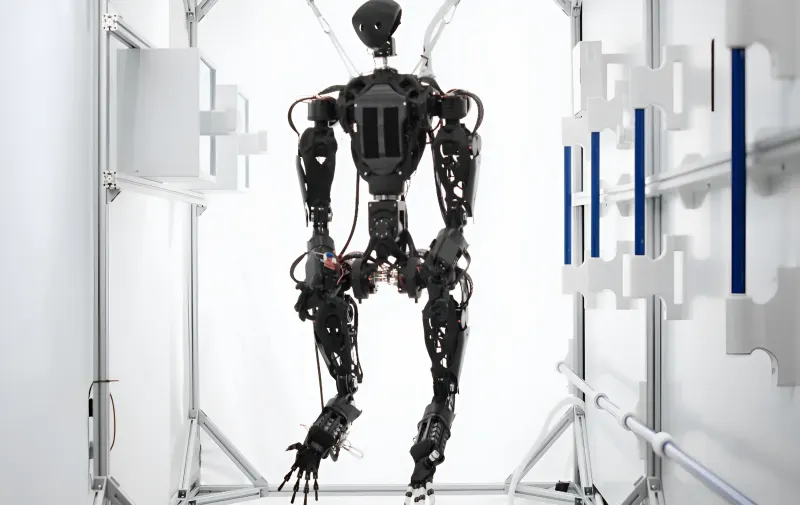
Canadian startup Orbit Robotics is challenging traditional concepts of robotics. Their new project, the humanoid HELIOS, is designed not for walking on Earth, but for living and working in open space. Instead of legs, it has four fully functional arms, making it an ideal candidate for tasks in microgravity.
Most modern androids are designed with Earth's gravity in mind, where stability and the ability to walk on two legs are key factors. However, in weightlessness, legs lose their practical value. In orbit, movement and body stabilization depend on the ability to grab onto handrails and surfaces.
That is why HELIOS features a radical concept: four arms and four hands controlled by a unified computer vision system. This design allows the robot to securely anchor itself with two limbs while the other two perform service tasks — from satellite maintenance to assembling orbital structures.
Engineering Solution: Flexibility Instead of Rigidity
Unlike heavy and rigid industrial actuators, HELIOS uses a flexible mechanical system that ensures high precision and efficiency:
- Reduced moving mass: all electric motors are shifted closer to the shoulder joints. This allowed the limbs themselves to be lighter and increased the energy efficiency of movements.
- Tendon drive: force is transmitted to the joints via a complex network of cables, coils, and pulleys. This structure makes the robot flexible and capable of the delicate, precise manipulations required in space.
- Rolling joints: the humanoid's elbows use a roller contact mechanism, which ensures smooth movement with minimal friction while maintaining high strength.
Economic Impact and Future of the Project
According to Orbit Robotics estimates, astronauts on space stations currently spend about 35% of their time on routine maintenance and inventory tasks. For example, one cycle of unloading a cargo ship takes the crew nearly 50 hours of work. Considering that an astronaut's hour in orbit is valued at approximately $140,000, automating these processes will save colossal amounts of money.
The main goal of the project is to completely transfer logistics, inventory checks, and minor repairs to HELIOS, freeing up humans for scientific research and expertise.
Parallel to the development of HELIOS, the company is actively developing the IKARUS platform, assembled in just two months. IKARUS serves as a testbed for experiments with teleoperation, AI model simulation training, and refining two-handed autonomous operation technology. In the future, these developments will form the basis of the final version of the four-armed space android.


