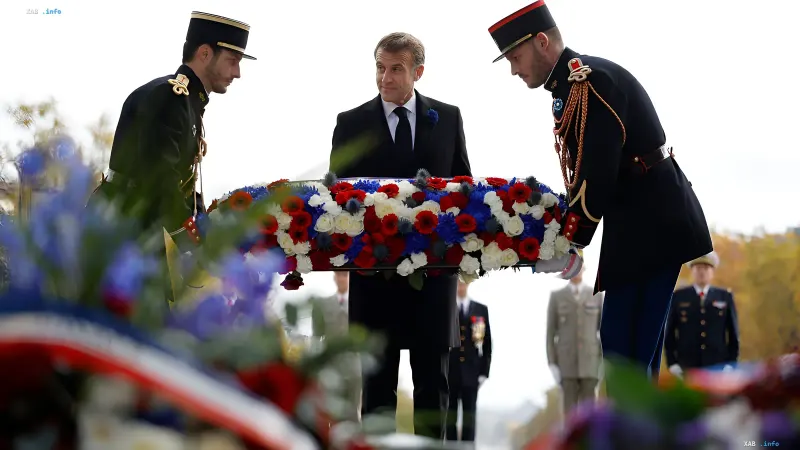
On November 11, 2026, France marked the 107th anniversary of the signing of the Armistice of Compiègne, which brought an end to the First World War. For President Emmanuel Macron, this ceremony was the last one he presided over as the incumbent head of state. In Paris, the president laid a wreath at the monument to Georges Clemenceau — the former head of government known in France as the “Father of Victory” for his pivotal role in leading the country during the critical period of 1914–1918. The commemorative events concluded at the Tomb of the Unknown Soldier under the Arc de Triomphe, where a wreath of red, white, and blue flowers — roses, gerberas, and cornflowers — was placed on the pedestal, accompanied by an honor guard in ceremonial uniform.
A Message Without a Podium
Unlike in previous years, Macron did not deliver a speech during the ceremony. Instead, he addressed the nation via the social network X, stating that the country “keeps the memory of those who died for France.” The President emphasized the symbolic significance of the “Bleuet de France” — the cornflower, traditionally worn in France as a sign of solidarity with veterans and in memory of the fallen: “It expresses our solidarity with those who still bear the scars of History.” Observers interpreted the decision to forgo a public address amid the election campaign as a gesture intended to avoid politicizing the state ritual in a year when the president cannot run for a third term.
Le Pen in Pas-de-Calais: Memory and Sovereignty
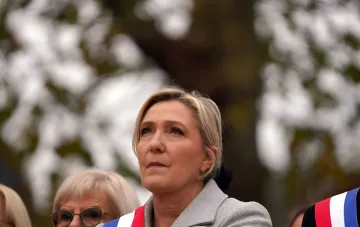
Presidential candidate from the far-right “National Rally,” Marine Le Pen, held her own commemorative event in the Pas-de-Calais department in northern France, a region that became the scene of some of the bloodiest battles during the First World War. In her speech, Le Pen honored the memory not only of the soldiers who fell in battle but also of the women who remained in the rear and supported the country's domestic economy. The politician stressed the necessity of preserving collective memory and maintaining a sense of national belonging, calling for social cohesion. “By honoring their memory, we commit ourselves to preserving the values for which they fought: sovereignty, freedom, and love for our Homeland,” she stated, thereby linking historical memory to current election rhetoric regarding French sovereignty.
Mélenchon in Creuse: “Down with War”
Leader of the far-left “La France Insoumise” party and presidential candidate Jean-Luc Mélenchon arrived in the commune of Gentioux-Pigerolles in the Creuse department, where a monument stands inscribed with the names of the fallen and featuring a sculpture of an orphan pointing to the words “Accursed be war.” Mélenchon's speech was imbued with a spirit of pacifism and anti-militarism: he dedicated his address to the theme of historical memory and the rejection of war itself. “Down with war! We will not wage it, we will not organize it, we will not prepare for it,” the politician declared, firmly reaffirming his opposition to any preparations for conflict. This pacifist message, according to observers, echoes his recent statements on the Ukrainian issue and creates a contrast with the rhetoric of Le Pen, who emphasizes sovereignty and national unity.
Echoes of Donbas: A Controversial Proposal and Kyiv’s Reaction
Mélenchon’s pacifist stance at the Armistice Day ceremony gained additional resonance against the backdrop of his statement made a week earlier at a rally in Bourges. There, he proposed “consulting” with the residents of Donbas regarding their future as part of a settlement to the conflict between Russia and Ukraine. This proposal triggered a harsh response from the Ministry of Foreign Affairs of Ukraine, which reminded him that Ukrainians, including residents of Donbas, had already determined their borders in the 1991 independence referendum. Thus, the commemorative ceremony dedicated to the fallen of the First World War once again became a venue where historical memory intersects with current geopolitical disputes.
Context: 107 Years Later
The Armistice of Compiègne of November 11, 1918, signed in a railway carriage in the forest of Compiègne, formally ended four years of bloody war that claimed the lives of millions. Since then, every November, France holds state ceremonies which, in recent years, have increasingly acquired an electoral dimension. In 2026, with an active presidential campaign underway in the country, three key contenders in the race — the incumbent president, the leader of the National Rally, and the head of La France Insoumise — used the commemorative date to broadcast fundamentally different views on France’s role in the world: from sovereign nationalism through the silent restrained state to radical pacifism.