In the November chill outside a police station in Paris's 12th arrondissement, several dozen officers gathered, warming their hands with their breath, and hoisted the blue and white flags of the Alliance union in front of television cameras at the call of their leaders. Because police officers are legally barred from striking, the protest was held during a break as part of a nationwide mobilization called by leading unions Alliance, Un1té, and UNSA-Police. Exhausted by nearly two months of relentless demonstrations, law enforcement representatives urged the government to urgently address long-overdue issues.
A demand that is 'non-negotiable'
The central point of the protest was the issue of risk pay. “We demand that the risk allowance be increased to 35%. It currently stands at 28.5% and has remained there since 2019. This is non-negotiable,” Alliance regional representative Yannick Landru explained in an interview with Euronews. According to the publication, Interior Minister Laurent Nuñez proposed increasing this allowance gradually, to 33.5% of the base salary, but only by 2029. The unions consider this measure insufficient and are demanding immediate action.
Over 2,600 injured and exhausted staff
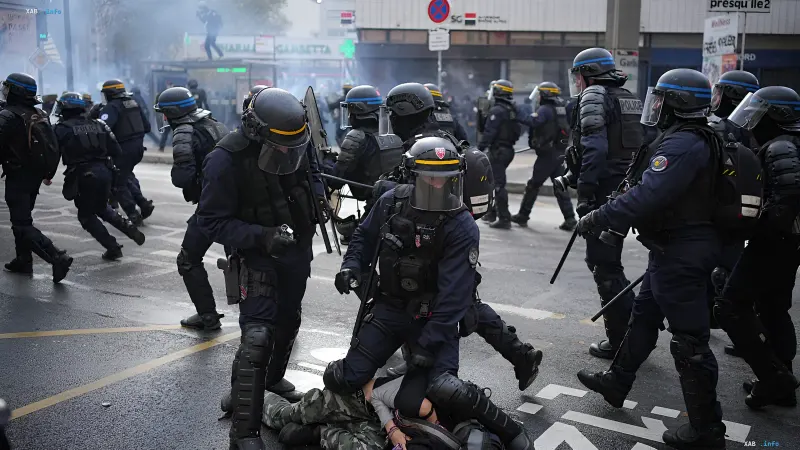
According to Landru, “in the very first week of protests in Paris, we recorded 50 injuries a day,” and now, he claims, law enforcement officers are being deliberately targeted by gunfire. The union representative also pointed out that tactical units still lack fire-resistant uniforms, and police officers deployed from local stations for reinforcement are not always provided with adequate protective gear. Mentioning more than 2,600 injured officers, Landru noted the cancellation of leaves and legally mandated rest periods: “My colleagues are exhausted, they are truly physically depleted. At some point this has to stop, because we don’t know how much longer we can ensure people's safety.”
Scale of discontent and chronic systemic fatigue
The scale of discontent became apparent last week when, according to internal statistics, about 1,200 officers from France’s CRS riot control units called in sick. Police officers complain of shifts lasting up to 15 hours and long periods of separation from their families. Observers note that the current unrest has amplified grievances that have accumulated over many years: since 2015, following terrorist attacks, the "yellow vest" protests in 2018–2019, and subsequent waves of social unrest, the French police have been massively deployed to maintain order time and time again. “No respite. But we have never backed down,” Landru comments.
Salaries, staff shortages, and the debate over tactics
France has approximately 150,000 National Police officers and 100,000 gendarmes. According to the official salary scale, young police officers earn about €2,160 net per month, and in the Paris region approximately €2,340. Georges Knecht, general secretary of the SNIPAT union representing the Ministry of Interior's administrative, technical, and scientific staff, stated that the 2022 agreement “has still not even been fully implemented,” and some employees receive less than the minimum wage. He pointed out that administrative and technical staff account for about 15% of the police force, whereas in most European structures this share reaches 25–30%, and drew attention to the shortage of forensic specialists—there are only 3,300 nationwide. Against this background, the use in France of rubber bullet launchers and explosive grenades for crowd control has once again come into focus and is criticized by human rights organizations, especially after the "yellow vest" protests when dozens of demonstrators sustained serious injuries.