
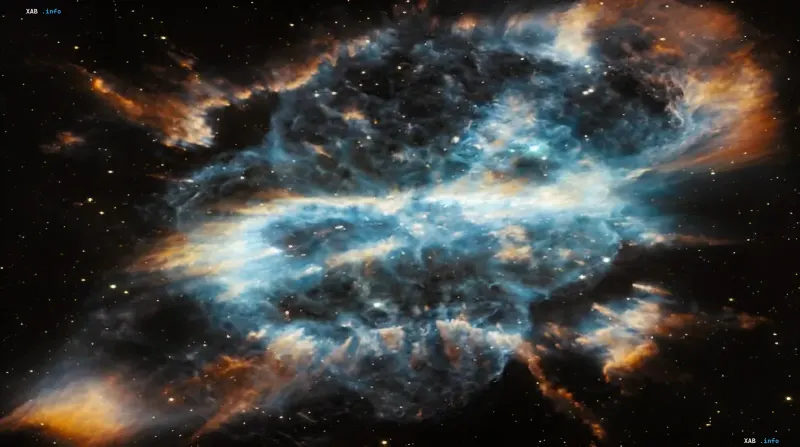
The James Webb Space Telescope has made a discovery capable of overturning our understanding of how the early Universe evolved. An international team of astronomers has recorded a process that literally blows the life out of a young galaxy, depriving it of the ability to birth new stars. The study, published based on observatory data, offers a new explanation for the mystery of the mass appearance of "dead" galaxies in an era when they should have been actively growing.
The Mystery of "Dead" Galaxies
Astronomers have long faced a paradox: in the young Universe, just a billion years after the Big Bang, a significant number of galaxies are found where star formation has already ceased. From the perspective of classical evolution models, such objects should have been in a phase of vigorous development. Previously, scientists linked this phenomenon exclusively to the activity of supermassive black holes, which could push gas out of galaxies. However, new data points to another, no less powerful mechanism.
CRISTAL-02 System: A Laboratory of Cosmic Cataclysm
The focus of the researchers was the galactic system CRISTAL-02. Observing it, astronomers saw what it looked like in the distant past. This is not a single galaxy, but a system of several objects in the final stage of merger. It is precisely this process of cosmic collision that triggered a chain reaction leading to the rapid extinction of the system.
During the merger, huge volumes of gas were directed into the central regions, triggering a real explosion of star formation. Stars in this system form approximately twice as fast as in ordinary galaxies of comparable mass. But it is precisely this hyperactivity that became the cause of death.
Death by Success: The Galactic Wind Mechanism
Massive young stars, born at such rates, have short lives and quickly end them in supernova explosions. These explosions generate powerful shock waves that create destructive galactic winds. In the case of CRISTAL-02, the cumulative effect of these processes was so strong that the galaxy began to lose its gas reserve—the main building material for future stars.
Lead author Rebecca Davis from Swinburne University of Technology in Australia notes that if the gas loss process continues at current rates, the galaxy will completely cease star formation in less than 50 million years. This is an astronomically short period during which an object transforms from an active "stellar cradle" into a "dead" structure.
A New Model of Universe Evolution
The discovery of the mechanism by which a galaxy "kills" itself due to excessive star formation is of fundamental importance. According to scientists, a similar scenario could have been widespread in the early Universe. Almost half of the massive young galaxies of that time show signs of interaction or merger with neighbors.
Thus, the rapid depletion of gas reserves caused by galactic winds was likely one of the main reasons for the appearance of a large number of "dead" galaxies already at the early stages of cosmic evolution. This discovery helps scientists better understand how the first large structures of the Universe formed and why some of them ceased development significantly earlier than previously assumed.


