
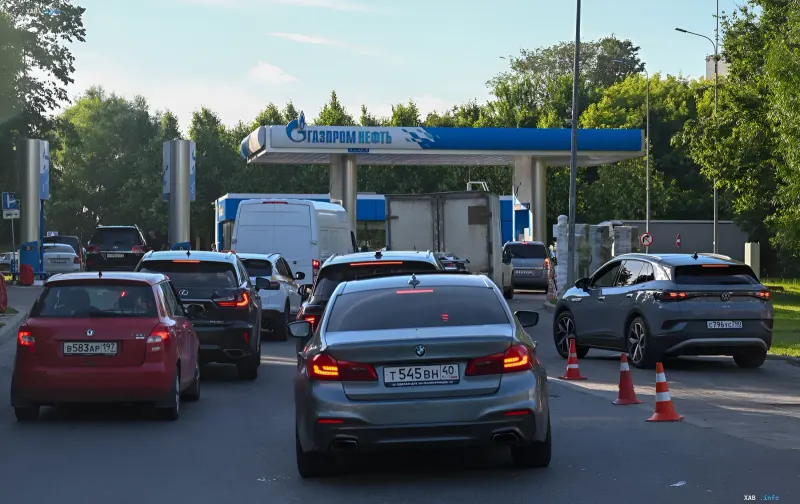
A large-scale fuel crisis is unfolding in Russia, the consequences of which have already affected the lives of millions of citizens. According to data published by RBK-Ukraine citing the Telegram channel "We Can Explain," gasoline for the population has completely disappeared in six regions of the country. The situation is exacerbated by the fact that in many other regions of the Russian Federation, refueling is possible only in regional centers, while in district towns and villages, gas stations are operating with interruptions or are closed.
Deficit Map: Where There Is No Fuel
In response to the growing tension in the country, a fuel availability map was launched. According to it, there are no working gas stations in Kabardino-Balkaria, Ingushetia, Chechnya, Dagestan, Magadan Oblast, and Chukotka. This means that residents of these territories have effectively been left without the ability to travel in their personal vehicles.
The problem is particularly acute in Dagestan, where authorities were among the first to introduce strict restrictions: no more than 20 liters of gasoline and 50 liters of diesel fuel per person. The measure is intended to ensure the even distribution of remaining fuel, but it only highlights the depth of the crisis.
Priority for Officials and Government Structures
Despite the acute shortage of fuel for ordinary citizens, vehicles of state bodies continue to function without interruption. In a number of regions, including Saratov, Volgograd, and Krasnodar, fuel at "Rosneft" gas stations is dispensed exclusively to emergency service vehicles, representatives of district administrations, MFCs, and "Russian Post".
Such a practice creates a double standard: while ordinary drivers stand in queues or cannot find fuel, officials refuel out of turn or through separate supply channels.
Regional Differences and Denial of the Problem
The situation varies from region to region. For example, in Astrakhan Oblast, the fuel deficit is obvious, but local officials deny its existence, attributing the queues to seasonal demand. In the neighboring Volgograd Oblast, the map records more than 20 working gas stations, creating a contrast with the neighboring region.
In the Kaliningrad Oblast, authorities announced additional supplies and the introduction of temporary restrictions to stabilize the market. However, even these measures do not guarantee the full restoration of fuel availability for the population.
International Context and Attempts at Resolution
Russia began taking gasoline from Belarus that was intended for Central Asian countries. However, even record volumes of such supplies do not allow the deficit to be fully overcome. Kazakhstan, for its part, has limited border crossings for cars to once a day to stop the mass removal of fuel from the country.
At the end of June, restrictions on gasoline sales or interruptions in its supply were observed in almost 90% of Russian regions. Fuel prices reached record levels, which further hit citizens' wallets.
Official Position
Russian leader Vladimir Putin acknowledged the difficulties in ensuring fuel supply but assured that the situation is allegedly "not critical." However, the facts say the opposite: the absence of fuel in entire regions, the introduction of strict limits, and priority supply to government structures indicate a serious systemic crisis.


