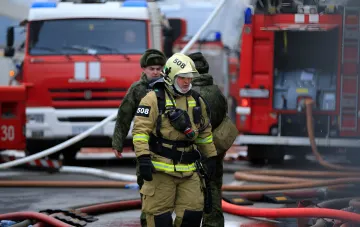
The largest Russian petrochemical complex, Gazprom Neftekhim Salavat, located in the Republic of Bashkortostan, has once again been targeted in an attack. The incident occurred against the backdrop of a series of strikes on critical infrastructure facilities recorded over recent months. The distance from the city of Salavat to the border with Ukraine is about 1,400 kilometers, which highlights the range of the weapons used and the changing nature of threats to remote rear regions.
Scale of the Emergency and Visual Evidence
Judging by materials published in local public pages and social networks by eyewitnesses, a powerful fire broke out a few kilometers from the city limits of Salavat. A preliminary analysis of the video materials and photographs indicates that the epicenter of the fire is located directly within the industrial zone of the oil refinery. Local residents reported hearing explosion sounds preceding the appearance of open fire and plumes of black smoke.Contradictory Data
Official Russian agencies and the management of the enterprise itself as of October 8, 2026, refrain from official comments or confirming the fact of the attack. At the same time, independent sources, OSINT analysts, and Ukrainian specialized publications claim that the facility sustained new damage. Estimates of the distance to the border also vary: some sources indicate 1,300 km, while cartographic calculations provide about 1,400 km. The exact scale of the destruction currently remains unclear due to the lack of official data.Significance of the Facility and Chronicle of Previous Strikes
The Gazprom Neftekhim Salavat enterprise plays a critically important role in Russia's fuel and energy sector, possessing a processing capacity of up to 10 million tons of raw materials per year and producing over 150 types of products, including automotive gasoline, diesel, and fuel oil. The complex is regularly subjected to strikes: memorable attacks include September 24, 2025, as well as incidents on July 14 and August 13, 2026, when, according to analysts, technological oil processing processes at the enterprise experienced serious disruptions and shutdowns.