
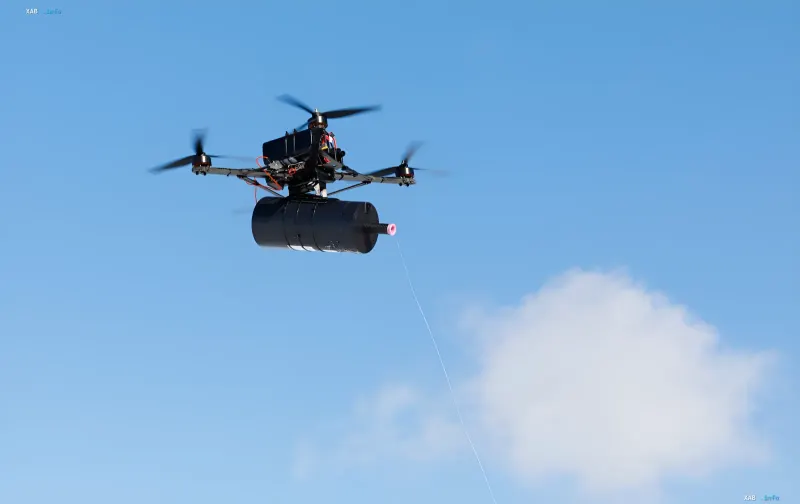
By the end of spring 2024, products from the company 'General Chereshnya' took first place in the 'Delta' combat results accounting system. This was made possible by the high efficiency of using the equipment on the battlefield, confirmed by video footage and verified data.
'The Arithmetic of War': the 'Delta' System and the Leadership of Ukrainian Development
Co-founder of the company Yaroslav Hryshyn told RBC-Ukraine in an interview that it was precisely the combination of all models — from FPV drones to specialized interceptors — that allowed such a result to be achieved. The 'Delta' system only counts confirmed hits, not just the number of devices launched. Here, 'General Chereshnya' showed the best indicators among all manufacturers.
"This is truly an innovative breakthrough," noted Hryshyn. "The 'Delta' system has been adopted by the Ministry of Defense of Ukraine, and all results in it undergo strict verification. This allows for an objective assessment of the effectiveness of each unit of equipment".
Efficiency Over Volume: KPIs Close to 100%
It is important to note that the company is not the leader in terms of supply volume — its advantage lies elsewhere: in quality and effectiveness. For example, units using 110 AIR anti-aircraft interceptors are capable of shooting down up to 100 targets. That is, the coefficient of useful action (KPI) approaches 100% — a unique indicator for modern warfare.
The company's arsenal includes two key models of front-line interceptors — AIR and AIR Speed. They perform different tasks: AIR operates at speeds up to 170 km/h, while AIR Speed reaches up to 240+ km/h. There is also a faster interceptor, Bullet, capable of reaching speeds of up to 327 km/h under extreme conditions.
Fighting 'Lightnings': Growing Threats and Countermeasures
With the help of these devices, the security and defense forces of Ukraine shoot down about 40% of Russian 'Lightning' attack drones. At the same time, the enemy increases the number of launches of such drones by 50% every month. This forces Ukrainian developers to constantly modernize the equipment and increase its production.
"We need to constantly adapt to the needs of the front," emphasized Hryshyn. "Every month we analyze the enemy's tactics and make changes to the design and software of our drones".
Russian Copies and Ukrainian Superiority
Interestingly, Russia is trying to copy Ukrainian interceptor drones, but the results of such attempts are significantly inferior to the originals. According to Hryshyn, Ukrainian pilots remain more creative and experienced, while domestic engineers continue to improve the protection of pickups, tanks, and armored personnel carriers from aerial threats.
Production Doubled: 100,000 Drones Per Month
The company 'General Chereshnya' has doubled the production of unmanned aerial vehicles — now more than 100,000 units of equipment are produced monthly. A year ago, this figure was 50,000. The team works without days off to ensure the front has the necessary amount of equipment.
"We understand that every drone is a soldier's life," said Hryshyn. "Therefore, we do everything possible to make our equipment reliable, effective, and available in the required quantity".


