
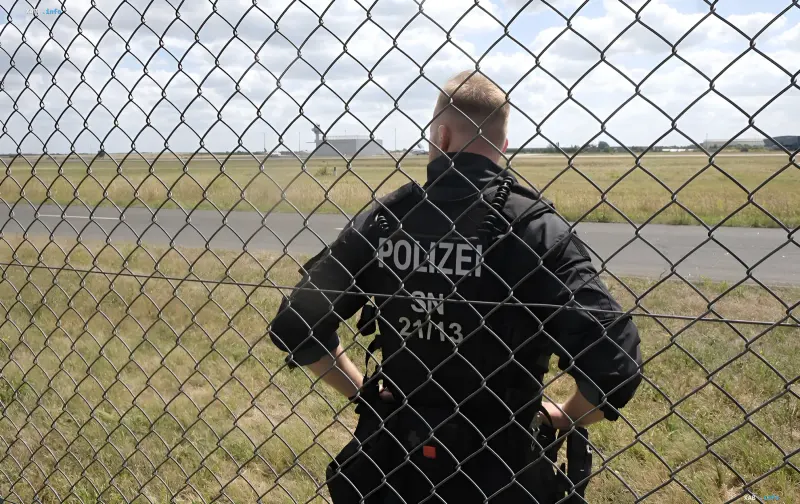
Germany has made an unprecedented diplomatic move against Moscow, announcing the closure of the Russian consulate general in Bonn. The decision is a direct consequence of the investigation into the attempted destruction of the Ukrainian Antonov Airlines cargo plane, the An-124 "Ruslan," at Leipzig/Halle Airport on 4 August 2026. Following the police and intelligence investigation, the federal government of the Federal Republic of Germany has, for the first time, publicly and categorically accused Russian state structures of orchestrating a hybrid attack on German territory. At the same time, Berlin has called for the introduction of a new package of sanctions against Moscow, marking a sharp change in tone in German-Russian relations.
Chronicle of the Leipzig attack: a drone carrying 800 grams of explosives
According to the investigation, late on the evening of 4 August, an FPV drone the size of a household microwave oven was found on the apron of Leipzig/Halle Airport in the vicinity of the Ukrainian An-124 aircraft. The drone was fitted with 800 grams of plastic explosive and an electric detonator. Analysis of surveillance camera footage showed that the drone had been hovering over the airport grounds since 19:28 local time. A key element of the sabotage scheme was a special SIM card built into the device: it allowed the drone to be controlled from a great distance while simultaneously masking its signal as that of an ordinary mobile phone, rendering it invisible to standard anti-drone defense systems. The investigation also uncovered traces of an explosion in the abandoned settlement of Kursdorf near the airport, as well as a relay antenna that the saboteurs likely used to boost the telemetry signal. The drone crashed into the fuselage of the Ukrainian aircraft, but by coincidence the detonation did not occur — the explosive device detached at the moment of impact and was subsequently defused by a sapper robot. Leipzig/Halle Airport is one of the key logistics hubs for both the German and Ukrainian Antonov fleets in Europe, so, according to expert assessments, the aim of the attack was to destroy the strategic aircraft and disrupt the chains of military-technical assistance.
A wave of sabotage: from Augsburg to Brandenburg
The Leipzig attack was not an isolated incident. On the morning of 2 September, an explosion went off at the central railway station in Augsburg, Bavaria, injuring two Ukrainian citizens. The day before, on 1 September, a sabotage attempt was made on the Turnow/Praylak substation near Brandenburg: unknown individuals damaged several power lines, causing a technical failure at the nearby Enschwalde power plant. In the assessment of German authorities, the totality of these incidents indicates a systematic character of sabotage activity on the territory of the Federal Republic of Germany.
Berlin's official reaction: from investigation to sanctions
Interior Minister Alexander Dobrindt emphasized at a press conference that the planning of the Leipzig sabotage was "professional and coordinated by Russian state structures." "Taken together, the police investigations, the modus operandi, and the intelligence data prove Russia's responsibility for the attempted attack. Accordingly, the federal government concludes that Russia bears responsibility for the hybrid attack," he stated. Foreign Minister Johann Wadefuhl, for his part, declared that the Russian leadership regards the Federal Republic of Germany "with open hostility," and added: "With the attempted attack in Leipzig, the Russian leadership has in effect deliberately decided to deepen and significantly damage our already very strained bilateral relations." The closure of the consulate general in Bonn and the demand for a new sanctions package mark the first instance in which Berlin has moved from investigative actions and convictions of specific perpetrators to institutional measures of pressure on Moscow.
Expert analysis: why Germany responded now
Anna Shelest, Director of Security Programs at the "Ukrainian Prism" Council of Foreign Policy, noted in a comment to RBC-Ukraine that, despite the sharpness of the reaction, such measures had been prepared in advance. "Germany usually takes a long time to get moving, but such measures were prepared earlier. Questions had already been raised about the 'Russian House' in Berlin and the consulate in Bonn," she said. In her words, the key factor was the change in the nature of the threats: "There is a different level of operations. If it was just information operations, they tried to respond in one way. When the problem became that this is in fact terrorist activity and military, they can clearly prove it, so responding too weakly would be a problem not only in relations with Ukraine, but before its own population: whether the country is ready, or not, for any incident." Ivan Us, an associate expert at the "United Ukraine" analytical center, in turn, drew attention to the factor of Germany's informal leadership in the EU: "This also puts pressure on the German leadership, which understands that they are the main economy of the European Union. And an attack on any EU country is, first and foremost, an attack on Germany."
Possible consequences and mirror measures
The closure of the consulate general in Bonn, according to several sources, may become a trigger for mirror actions by Moscow: in St. Petersburg, the possibility of closing the German consulate general is already being discussed. Experts warn that the escalation of the diplomatic confrontation against a backdrop of ongoing sabotage incidents could further fragment the already limited channel of communication between the two countries. For Ukraine, whose logistics chains through Leipzig/Halle Airport were the direct target of the attack, Berlin's hardline stance is an important signal that the security of Ukrainian aviation infrastructure in Europe has become a matter of direct commitments by the German authorities.


