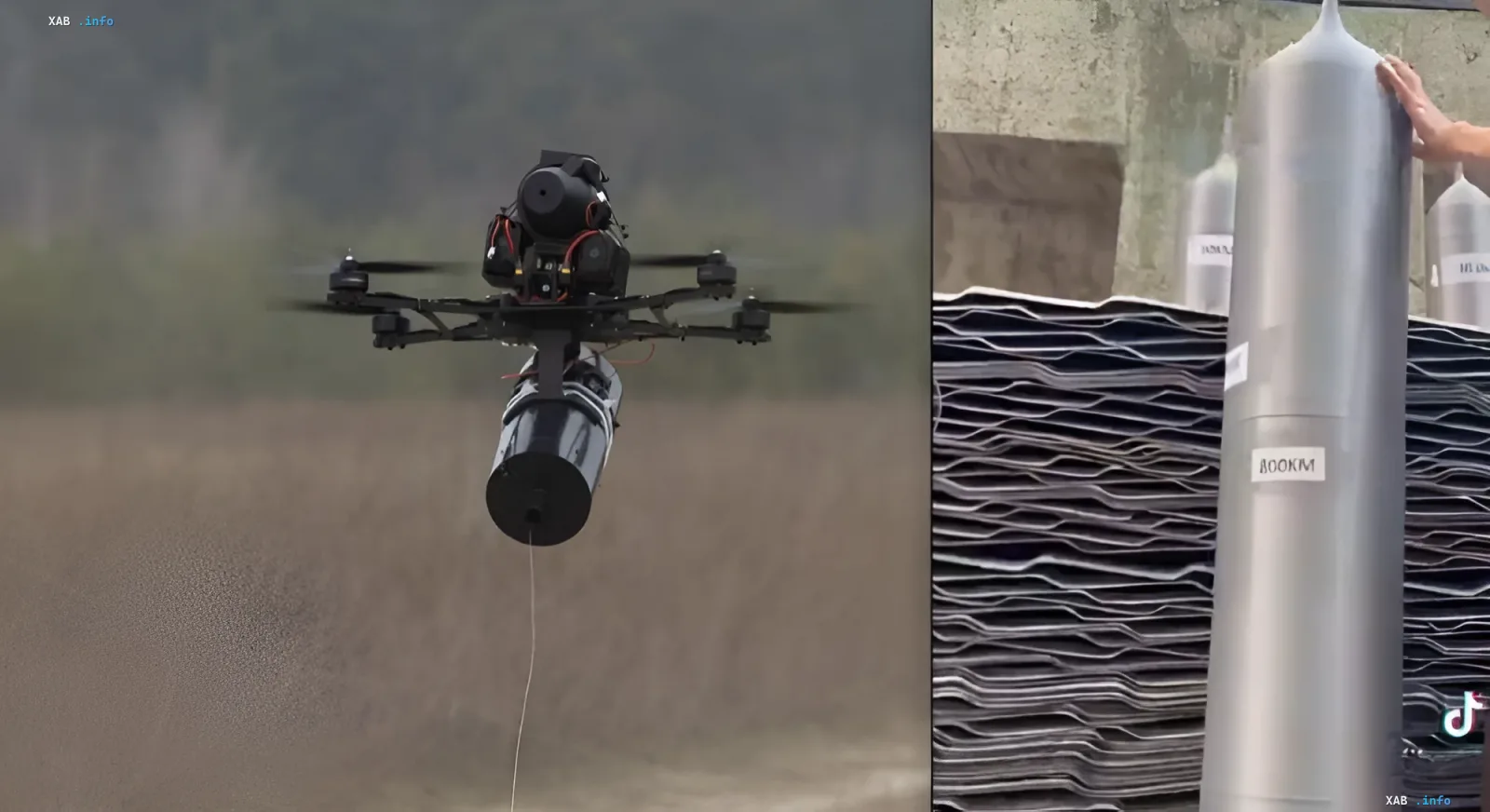
Videos demonstrating drones controlled via optical fiber of incredible length are gaining popularity in the Chinese segment of the internet. The footage shows huge spools marked with "500 km", "800 km", and even "1300 km". Visually, this looks like a breakthrough technology capable of changing the rules of aerial warfare, yet behind the facade of innovation lies a simple marketing trick.
The Illusion of Invulnerability
The idea of using fiber optic communication to control drones is indeed attractive to military analysts. Unlike radio communication, fiber optics cannot be jammed by electronic warfare (EW) means. If a drone existed that could fly 1,300 kilometers while remaining connected to the operator by a "cable," it would create colossal problems for the enemy's air defense systems. Real-time control without the risk of signal loss would seem like an ideal scenario.
However, as experts from the Defense Express portal note, the answer to the question of the reality of such devices is a categorical "no." The problem lies not in engineering ingenuity, but in the fundamental laws of physics.
Physical Limitations
The main obstacle to creating such systems is signal attenuation. The laser beam transmitting data through the optical fiber inevitably scatters as it travels. The longer the cable, the weaker the signal at the output.
Analysts point to the following factors limiting the range:
- The wavelength of the light used.
- The type and quality of the fiber itself.
- The method of winding the spool.
- The power of the transmitting equipment.
Even with the use of the most advanced equipment and ideal conditions, the theoretical limit of direct signal transmission without amplifiers is approximately 200 kilometers. To increase the range, signal repeaters are required, which cannot be placed inside a single giant spool wound onto the drone.
Marketing Instead of Innovation
The debunking came from experts who analyzed the origin of the videos. It turned out that the demonstrated giant spools are just a promotional gimmick. The spools themselves are printed on a 3D printer and do not contain optical fiber inside. Their goal is to create a visual effect and attract attention to web pages where real, but much more modest, spools of 10–60 kilometers are sold.
Developers counted on the fact that ordinary viewers, unfamiliar with the physics of data transmission, would believe in the existence of a "magical" product that violates the laws of nature. Such content spreads quickly, creating the appearance of a technological breakthrough that is actually just a beautiful illustration.
China's Real Developments
Despite the spool hoax, China continues to actively develop stealth technologies for unmanned aerial vehicles. Recently, there were reports of the creation of a new series of aerosol coatings, the XRAM-C Series. This paint is capable of hiding drones from radars by absorbing radio waves and converting them into heat, unlike ordinary metal, which reflects the signal. In this case, we are talking about real technologies capable of "blinding" the enemy's detection systems.


