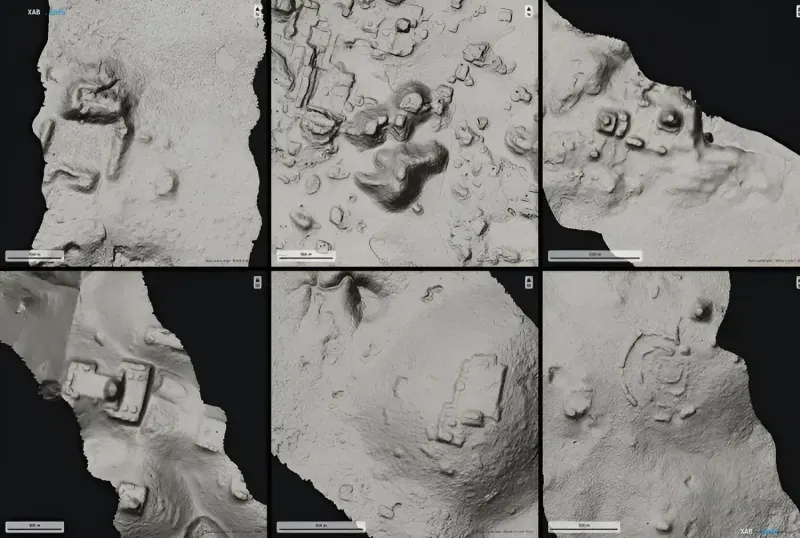
Google researcher Pietro Miotti used 48 AI agents to search for unknown archaeological sites using NASA data. The system worked with images obtained via LiDAR (light detection and ranging), which allows for the creation of detailed three-dimensional surface maps. Initially, Miotti planned to search for monuments in Peru, but due to a lack of publicly available data, he switched to the Maya civilization region in Mexico. According to him, less than 72 hours passed from the initial idea to the official response from Mexican authorities.
How the AI 'found' the settlement
The agents identified several promising areas, including a large settlement that, Miotti claimed, was absent from the registries known to him. To verify the status of the object, he contacted Mexico's National Institute of Anthropology and History (INAH), translating his correspondence into Spanish using AI. The institute's response stated that its database contained no information about a registered site at the specified location. Miotti took this as confirmation of a potential discovery and publicly announced the find.
Why the 'discovery' turned out not to be new
Archaeologists quickly established that this settlement had already been described in a scientific publication more than a year ago. Co-author of that work, archaeologist Ivan Šprajc of the Research Centre of the Slovenian Academy of Sciences and Arts, explained to The Verge that the absence of an object in the INAH database does not mean it has not been noticed or studied by specialists. The coordinates of archaeological monuments are often not published, so checking against a state registry is not enough: images must be cross-referenced with scientific literature.
Admitting the mistake and the limits of AI
Miotti acknowledged the mistake, explaining that he is not an archaeologist and did not know the difference between an object being absent from the official registry and its absence from archaeological maps. He updated his publication to include information about the specialists' prior work and agreed that AI results require expert verification. At the same time, the researcher maintains the opinion that his approach can help archaeologists process large volumes of remote sensing data more quickly.
The main problem is funding, not searching
Archaeologists pointed to a more fundamental issue. According to Elizabeth Graham from University College London, Maya region specialists are aware of numerous settlements that have yet to be excavated or mapped in detail, many of which are discovered by local residents during fieldwork. The main difficulty today is not a lack of potential finds, but a shortage of funding to study them. Šprajc added that simply detecting structures in LiDAR imagery still adds little to scientific knowledge.
A lesson for the scientific community
This case clearly demonstrates the limitations of AI agents in scientific work: they are capable of finding objects in massive datasets, but they do not necessarily determine what is already known about a find or what its significance is. Without checking publications, consulting specialists, and conducting fieldwork, a discovered object can easily be prematurely declared a new discovery. Archaeologists also warn that publishing the exact coordinates of monuments can attract looters, making the public disclosure of such data risky.