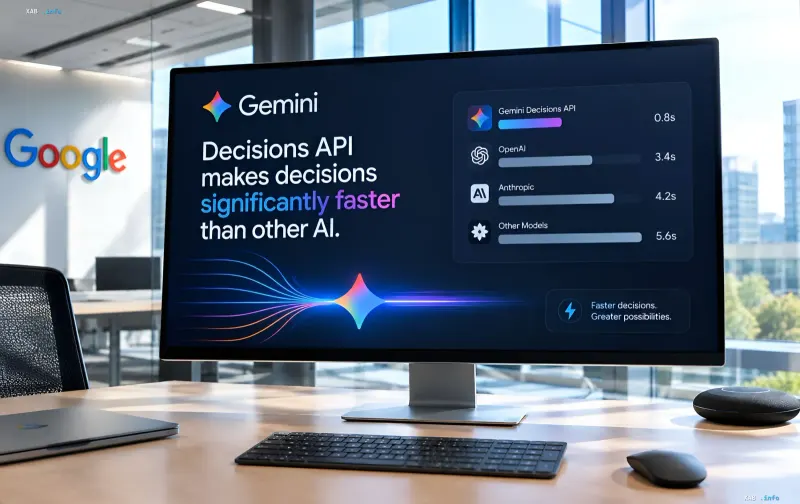
Google has officially introduced the Gemini Decisions API, a new programmatic interface built on the specialized Gemini Decision 1 model. Unlike traditional language models that generate responses sequentially, word by word, this tool focuses on mass parallel evaluation: in a single call, the system can process up to 1,000 independent questions based on shared multimodal data, without generating unnecessary text.
Parallel Evaluation Instead of Sequential Generation
The key difference of Gemini Decision 1 is how it handles response options. The model immediately evaluates several possible outcomes, calculates the probability of each, and displays its confidence level in its own choice. The interface supports text, images, audio, video, and PDF documents with a total volume of up to 256,000 tokens. According to Google, average computation time ranges from 50 to 100 milliseconds, with a total latency of 150–250 milliseconds.
Pricing and Positioning
The pricing for the new product is designed for high-volume scenarios: $0.10 per million input tokens with no additional charge for output data. The company emphasizes that this is nearly five times cheaper than the Gemini 3.5 Flash-Lite model. In its marketing materials, Google provides a comparison chart showing the latency of the Gemini Decisions API at 0.8 seconds compared to 3.4 seconds for OpenAI's solution, 4.2 seconds for Anthropic, and 5.6 seconds for "other models"; independent verification of these figures was not conducted at the time of publication. The service is already available through the Google AI Studio platform, including a free tier for prototyping.
Integration into Google's Own Products
The company is actively integrating the tool into its ecosystem. In the Gemini Notebook API, the model is used as a router that reduces daily query latency by 40 percent. In the Stitch platform, it helps instantly create interactive mockups from voice commands, and in the CC app, it selects emoji reactions from over 200 options. Additionally, Google Search uses the model as a protective layer to detect suspicious activity.
Partner Integrations and the AI Race Context
Alongside internal services, the Gemini Decisions API is receiving integrations with popular third-party platforms: OpenRouter, LangChain, Vercel, LiteLLM, Pydantic AI, Pipecat, LiveKit, and OpenCode. The launch of the interface comes amid heightened AI activity by Google: the company recently introduced its flagship Gemini 4 Argon model as a response to competitor offerings. Thus, the Decisions API becomes another tool in Google's strategy to maintain its position in the race against OpenAI and Anthropic.