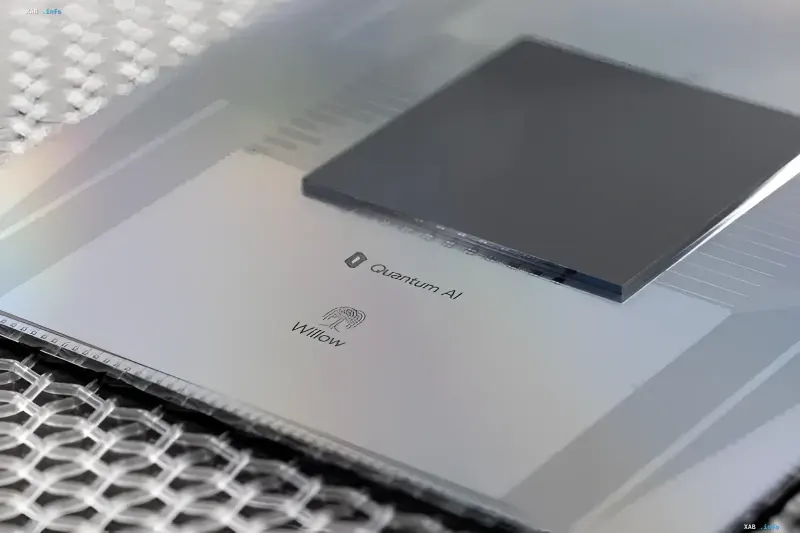
Google researchers have demonstrated that their experimental quantum computer, built on the Willow processor, is capable of outperforming any classical computing system in solving a logical problem known as the "magic square." The key to this result was the use of so-called quantum contextuality — a property of quantum systems in which the outcome of a measurement is not predetermined in advance but depends on the context of other measurements performed in parallel. It is precisely this feature that allows a quantum device to achieve what is fundamentally inaccessible to classical machines.
The rules of a game that measures the gap between paradigms
The task itself is structured as a consistency game: two participants must fill a 3 × 3 grid with numbers satisfying certain mathematical conditions, while being strictly forbidden from communicating with each other. Under such conditions, a classical computer can achieve only a limited number of wins, whereas Google's machine on the Willow processor showed a better result. Thus, the game serves as a tool for measuring the gap between two types of computing systems — classical and quantum.
Why qubits beat bits
The advantage arose thanks to the peculiarities of encoding information with qubits. In a conventional computer, a bit takes the value "0" or "1" even before it is checked — the reading process merely determines an already existing value. Qubits work differently: the outcome of their measurement depends on which other compatible measurements are performed in parallel. In the "magic square" game, participants can use this dependence to coordinate their answers more often than is possible with classical strategies — and all of this without any communication between the players. It is precisely this consistency of answers that contributes to an increase in the number of wins.
The numbers of the experiment: 98.30% versus 88.89%
A classical strategy allows achieving only 88.89% of wins. In the case of the Willow processor, the system lost in only about one case out of 60 over the course of 900,000 game rounds, showing a win rate of 98.30%. The difference of nearly ten percentage points is direct evidence that quantum contextuality provides a computational advantage unattainable for classical algorithms.
A "toy" task with real potential
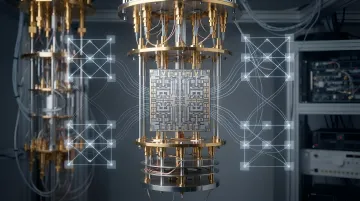
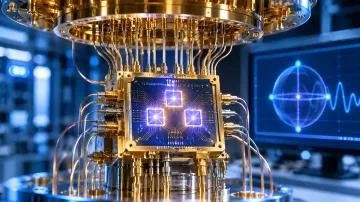
The experiment was carried out on Google's quantum computer in Santa Barbara (California). The machine is built on the basis of superconducting qubits — metal circuits cooled to a temperature close to absolute zero. At the same time, the researchers openly acknowledge that the game itself has no practical application: it is a "toy" task that demonstrates the capabilities of the equipment rather than solving any real applied problem.
What's next: from puzzle to computation
If scientists find a way to put the property of quantum contextuality to practical use, they will be able to perform computations that are beyond the reach even of the most powerful traditional computers. For now, Google is focusing not on solving a specific puzzle but on the fact that the quantum effect manifested itself in a processor that the company continues to refine. Thus, the "magic square" becomes not an end in itself but proof of the operability of the hardware platform on which the future of quantum computing is being built.