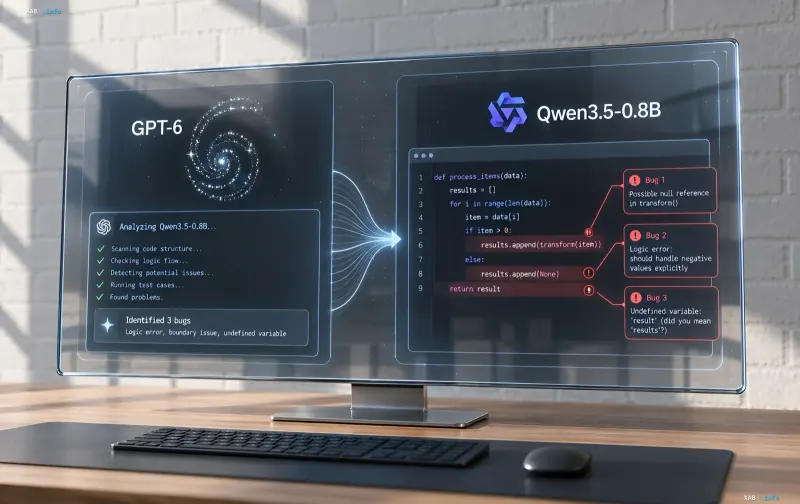
Researchers at the Massachusetts Institute of Technology (MIT) have published a blog post on GitHub demonstrating that OpenAI's flagship model, GPT-6 Astra, is capable of finding errors in other language models and fixing them by directly altering their internal parameters—the network's weights. The approach, dubbed Weight-Space Programming, bypasses the traditional fine-tuning procedure on data arrays and allows for the “manual” correction of a model's logic by analyzing its internal structure. The work was presented amid the active development of Astra, which OpenAI released in September 2026 and positions as the “most intelligent” AI system capable of performing multi-step professional tasks.
How the Experiment Works: From Weights to Logic
At the core of any neural layer lies a set of weights—massive arrays of numbers that determine how the model processes input data and generates output responses. Typically, to improve the quality of a neural network's performance, it is fine-tuned on additional data, which requires significant computing resources and time. The MIT team decided to test a fundamentally different scenario: could one AI system analyze the internal structure of another model and independently adjust its parameters without running a training process? GPT-6 Astra acted as the “surgeon,” while several smaller language and gaming neural networks served as the “patients.”
Key Result: Qwen3.5-0.8B Stops Looping
The scientists recorded the most striking effect when working with the Qwen3.5-0.8B model—a compact language model with about 800 million parameters. Before Astra's intervention, the system regularly got stuck in loops when solving math problems, repeating identical reasoning without converging on an answer. After GPT-6 Astra analyzed the model's weights and made targeted adjustments, results on the MATH-500 benchmark rose from 7.9% to 48.1%, and on GSM8K from 13.8% to 67.1%. Furthermore, the researchers noted a noticeable improvement in the model's ability to follow user instructions. In essence, Astra “found” a logic loop in the parameters and eliminated it without a single step of gradient descent.
Gaming Neural Networks: Recognition and Generation via Weights
In addition to language models, the MIT team conducted a series of experiments with neural networks trained on the arcade games Breakout, Pong, Pac-Man, and Freeway. Astra was shown the numerical parameters of four networks without running the games and without viewing the training process. The model successfully determined which game each neural network was created for, solely based on the weight structure. In another experiment, after receiving a textual game description and software environment, Astra independently generated parameters for three new neural networks for these games—without any training process. According to the authors, this demonstrates that neural network weights carry enough information for “reverse” model engineering.
Limitations: Why There Is No Universal Editor Yet
Despite impressive results, the researchers emphasize that universal editing of arbitrary models is still a long way off. In a control experiment with the Gemma 3 270M model, which made calculation errors without characteristic loops, Astra failed to significantly improve its metrics. The authors explain this by the fact that complex logical defects that do not manifest as explicit cycles or repetitive patterns are much harder to fix with targeted weight modifications. Nevertheless, according to the MIT team, the approach itself opens a new direction in AI development, potentially reducing or completely eliminating lengthy retraining cycles in the future.
Context: Where Else GPT-6 Astra Has Been Used
The publication of the MIT paper coincides with a series of demonstrations of Astra's capabilities in applied tasks. Previously, the model was used to decipher an 1809 cipher by Napoleon Bonaparte—a message to General Auguste de Marmont that had remained undecoded for over two centuries; recovering the 24-line text of about 1,300 characters took roughly six hours. OpenAI, in turn, positions Astra as a system capable of handling a wide range of delegated tasks—from filling out forms and analyzing scientific data to software testing—and company President Greg Brockman called the release a “generational shift.” The MIT work adds another direction to this list: Astra not only solves tasks but also serves as a tool for diagnosing and correcting other AI systems.