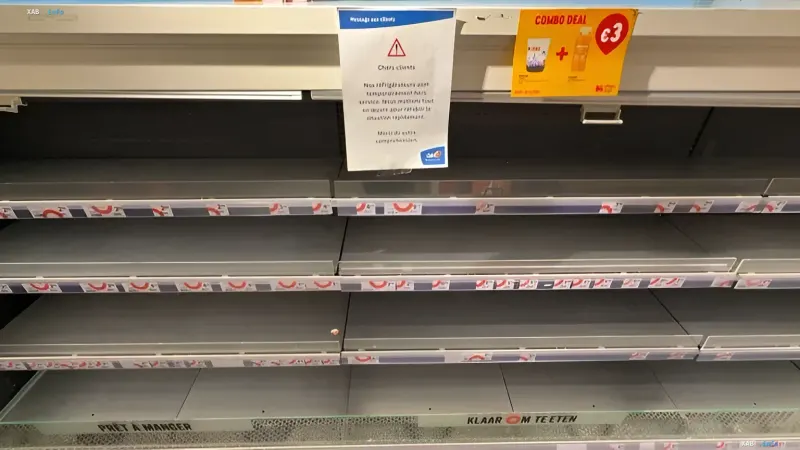
On the night of November 2, 2026, local time, cybercriminals launched a coordinated attack on refrigeration equipment in supermarkets and catering establishments across Europe. According to Reuters, the temperature in freezers and refrigerators was abnormally elevated — in some cases up to 50 degrees Celsius. By November 3, at least 11 European countries reported affected incidents. Stores had to urgently remove spoiled food from shelves, and in some cases, completely discard goods that failed to meet quality standards. Photographs published on social media show empty store shelves where bilingual information signs in French and Dutch — «Prêt à manger» and «Klaar om te eten» — indicated readiness for consumption, now left devoid of contents.
Attack Technique: Remote Control as an Infiltration Channel
A key feature of the incident was that hackers did not require physical access to the equipment. According to Professor Awais Rashid, a cybersecurity expert from the University of Bristol (UK), in an interview with Aljazeera, many cooling systems in supermarkets are controlled remotely, sometimes by third-party service companies, yet they lack necessary security software updates. «Many of these control systems have even reached the end of their technical support lifecycle,» he stressed. Stephane Moeelans, CEO of Belgian refrigeration equipment development company Sabcobel, told Euronews that during the attacks, the cooling system switched to defrost mode. «Remediating the vulnerability is not just about a software update; in some cases, it requires changing the system configuration and connection methods,» Moeelans explained.
Regulatory Response and Urgent Retailer Measures
The European Union Agency for Cybersecurity (ENISA) urgently called for coordinated and rapid information sharing to respond to the large-scale attacks. On November 3, European retailers carried out unscheduled system updates, checked for vulnerabilities, and disconnected potentially compromised refrigeration equipment from the network. European Commissioner for Agriculture and Food Christophe Hansen stated that the recent incidents indicate a deliberate disruption of supply chains and an undermining of public trust. At the same time, he confirmed that overall EU food security is not under threat, but the volume of spoiled food and business losses are of serious concern.
Economic Consequences and Supply Chain Threat
Direct losses include the cost of destroyed goods, equipment repair expenses, safety checks, and system restoration. For small retailers, these costs can create critical financial pressure. Furthermore, modern food distribution systems rely on an uninterrupted cold chain, especially for fresh and frozen goods. If incidents occur simultaneously at multiple locations or drag on, supply coordination is disrupted, increasing logistical costs and reducing the market's ability to meet demand. Notably, a few weeks earlier, hundreds of supermarkets in France had already been subjected to similar attacks, indicating a systemic rather than isolated nature of the threat.
Beyond Refrigerators: Vulnerability of Critical Infrastructure
Experts emphasize that the remote control technologies used in the refrigerator attack are also applied in building management systems, water supply, energy, warehousing, and transport. Professor Rashid noted that beyond financial damage to business, such incidents affect public perception of the reliability of vital services. Previously, cyberattacks were predominantly associated with data theft or financial fraud, but the European incidents of November 2026 demonstrated a new class of damage: a direct impact on the physical operation of equipment with material consequences in the real world.