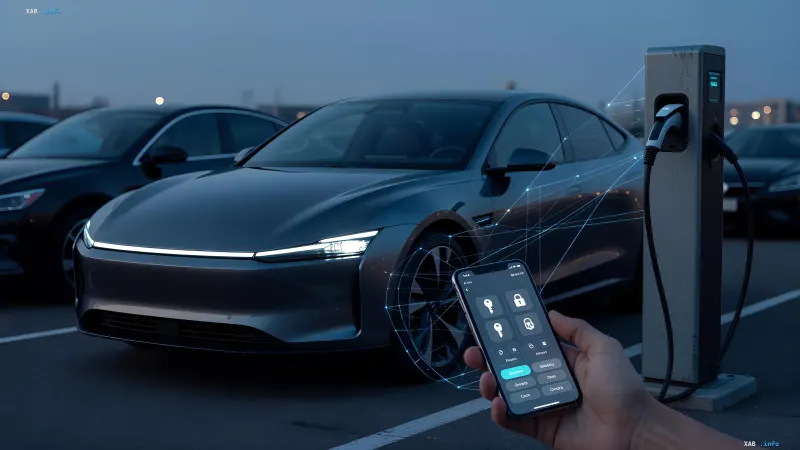
Cybercriminals have significantly expanded their arsenal of attack methods against automotive systems, moving beyond the usual Bluetooth and Wi-Fi channels. According to market experts cited by the Izvestia newspaper, attackers in 2026 are actively exploiting vulnerabilities in electric vehicle (EV) charging stations, alarm systems, and the digital infrastructure of car-sharing services. According to GLONASS JSC, approximately 120–130 cyberattacks on automotive systems were recorded in Russia between January and October 2026. Although this figure is lower than in the same period last year, specialists warn that the decrease is temporary and is due to attackers adapting to new penetration vectors.
Classical Methods Remain in Use
Despite the emergence of new vectors, basic attack techniques remain relevant. Malicious actors continue to use signal relaying of electronic keys—a so-called relay attack, where a device intercepts and amplifies the key signal, allowing the car to be opened from a distance. Another common method is connecting to the CAN bus via wiring or the OBD diagnostic port, giving the attacker direct access to onboard controllers: from operating locks and windows to manipulating the ignition and braking systems. These techniques, according to experts, remain the most common due to their relative ease of implementation and low barrier to entry for the attacker.
Charging Stations as a New Entry Point
The major innovation of 2026 is the use of EV charging infrastructure as an attack channel. Vulnerabilities embedded in the firmware and communication protocols of charging stations allow for intercepting charging sessions, remotely disabling equipment, and interfering with cost calculations. For an electric vehicle owner, this means not only financial losses but also the risk of unauthorized access to the onboard computer's data, which exchanges information with the station during charging. Risks are further amplified by the integration of battery management systems (BMS) with automakers' cloud services: compromising one link in this chain can give the attacker control over battery parameters, including its degradation and overheating protection.
Car Sharing and Logistics in the Crosshairs
The targets of attacks in 2026 are much broader than just private car owners. Car-sharing companies, commercial fleets, logistics platforms, and even gas station networks are at risk. Hacking the digital infrastructure of car-sharing can lead to mass access to customers' personal and payment data, tracking user movements, blocking entire fleets, and disrupting supply chains. For logistics companies whose operations are tied to connected vehicles and cloud-based dispatch systems, such an incident can paralyze operations for days.
Dynamics and Forecast: The Threat Will Grow by 2027
In 2025, 430 cyberattacks on automotive systems were recorded in Russia—21% more than in 2024. Experts attribute the current decline in the number of incidents in 2026 not to strengthened security, but to a period of attackers recalibrating their tactics to new vectors. They predict that the number of cyberattacks will rise again in 2027. A key driver will be the growth in sales of EVs and vehicles with connected cloud services, mobile apps, and remote control features. The more «digital perimeter» a vehicle has, the wider the attack surface—and the harder it is to ensure protection at every link.
What Owners and Companies Should Do
Experts recommend that automakers and infrastructure operators regularly audit the vulnerabilities of charging stations and cloud services, implement network segmentation, and use multi-factor authentication for access to onboard systems. Private users are advised not to connect their vehicles to unfamiliar charging stations, update onboard computer firmware as patches become available, and restrict access permissions in car management mobile apps. For car-sharing and logistics companies, it is critical to segregate networks for vehicle control and corporate IT systems, as well as to monitor for anomalous activity in CAN buses and cloud APIs.