
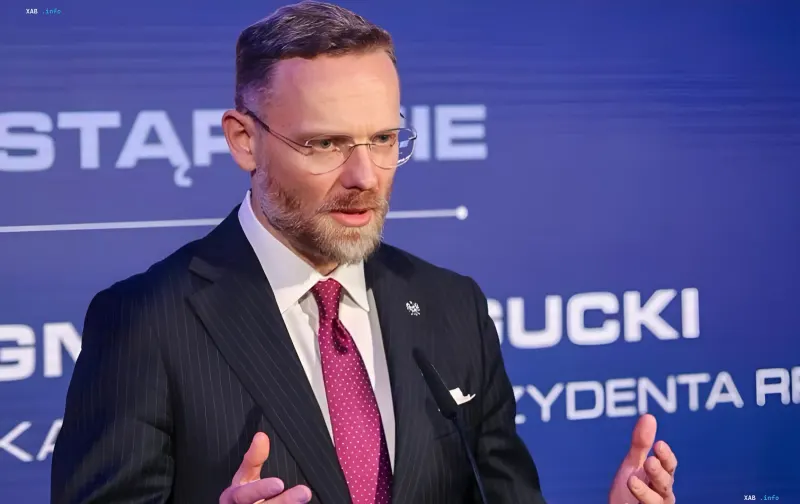
Zbigniew Bogucki, Head of the Chancellery of the President of Poland, has been officially added to the database of the Ukrainian 'Mirotdvorets' center. The reason cited is his public stance on the territorial affiliation of western Ukrainian regions, which the portal administration termed 'anti-Ukrainian propaganda'.
'Eastern Lesser Poland': A term dividing countries
The key reason for Bogucki's inclusion in the database was his comment made within the walls of the Polish Sejm. The official raised the issue of the Volhynian tragedy and used the formulation 'Eastern Lesser Poland' in relation to the western regions of Ukraine. This term is often used by supporters of the idea of 'returning' Ukrainian lands to Poland.
Experts from the 'Mirotdvorets' center highlighted several reasons for this decision. The resource administration calls on law enforcement agencies to pay attention to Bogucki's actions, considering them a deliberate attack against the international legal order and a direct threat to Ukraine's national security.
Political context and historical disputes
The statement by the Head of the Chancellery came against the backdrop of a tense political situation. A few days prior, Bogucki had stated that Western Ukraine does not correspond to 'Lesser Poland' neither historically nor in modern realities. At the same time, Ukrainian society continues to discuss the historical background of such assertions, calling them imperial chauvinism.
The escalation of the conflict occurred ahead of upcoming elections in Poland. An additional factor of tension was President Volodymyr Zelenskyy's decree naming one of the units of the Armed Forces of Ukraine 'named after the Heroes of the UPA', which also provoked a sharp reaction in Warsaw.
Warnings about disinformation
The Center for Countering Disinformation (CCD) previously warned that Russian special services are preparing an information campaign around the topic of the Volhynian tragedy. The inclusion of the Polish official in the 'Mirotdvorets' database has added a new layer to an already complex geopolitical situation, where historical narratives are becoming a tool of modern political struggle.


